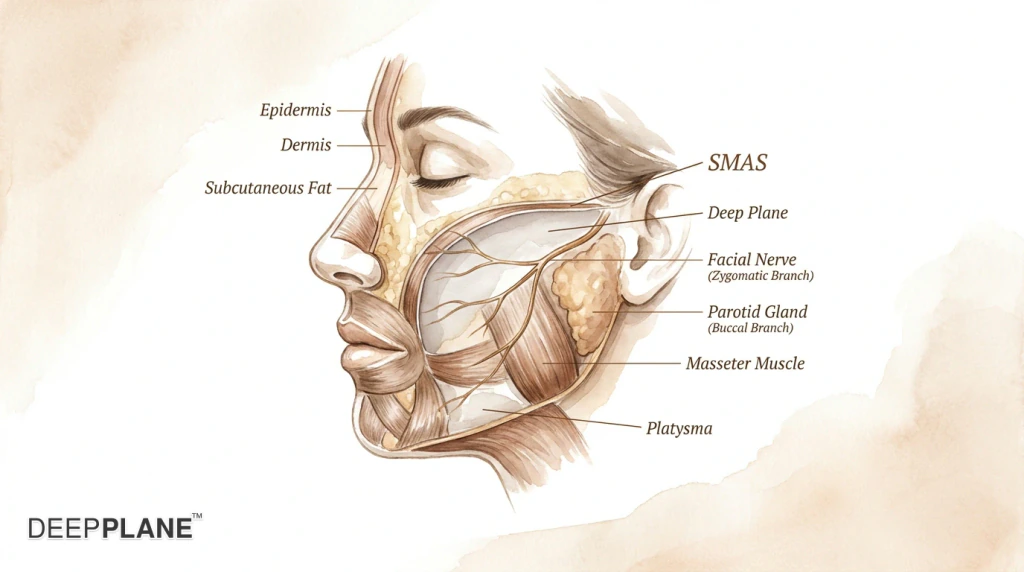


Deep plane facelift represents the pinnacle of facial rejuvenation surgery. Unlike traditional facelifts that merely tighten the skin, this advanced technique works at a deeper anatomical level to reposition the underlying facial structures, resulting in a more natural, long-lasting appearance.
Developed and refined over the past three decades, the deep plane technique has become the preferred method among elite facial plastic surgeons worldwide. The procedure addresses the fundamental cause of facial aging—the descent of deep facial tissues—rather than simply pulling on the skin.
According to DEEPPLANE™'s 2026 directory of 1200+ listed deep plane facelift specialists across 67 countries, the technique now accounts for the majority of long-longevity facelifts in high-volume practices, with 94.4% published patient satisfaction (Khoury et al. 2025, n=2,896).
How Does a Deep Plane Facelift Work?
How does a deep plane facelift work?
A deep plane facelift works by dissecting beneath the SMAS layer and releasing three facial retaining ligaments — zygomatic, masseteric, and mandibular — before repositioning the SMAS, the midface fat pad, and the overlying skin as a single composite unit. Because tension transfers to the repositioned deep tissues rather than the skin, the result avoids the pulled appearance and is long-lasting. (DEEPPLANE™ directory: 1200+ listed specialists across 67 countries.)
The SMAS Layer
The Superficial Muscular Aponeurotic System (SMAS) is a layer of tissue that connects the facial muscles to the skin. In a deep plane facelift, the surgeon works beneath this layer, releasing the retaining ligaments that hold the face in its aged position. See how this compares with the SMAS facelift technique, which tightens the same layer from above rather than below.
By releasing these ligaments—including the zygomatic, masseteric, and mandibular ligaments—the surgeon can lift and reposition the entire midface and lower face as a single unit, creating a natural, harmonious result.
Traditional Facelift
- Works only on skin surface
- Can create "pulled" appearance
- Suture tension can relax over time
- Limited midface improvement
Deep Plane Facelift
- Repositions deep facial structures
- Natural, refreshed appearance
- Results are long-lasting
- Comprehensive facial rejuvenation
What Are the Benefits of a Deep Plane Facelift?
What are the main benefits of a deep plane facelift?
A deep plane facelift delivers longer-lasting results, a more natural post-operative appearance that preserves facial expression, superior midface and cheek-pad rejuvenation through retaining-ligament release, and markedly reduced risk of the overpulled or windswept look. The trade-offs are a longer operation (4–6 hours) and a 20–40% higher surgical fee.

- Natural outcome. Because the technique repositions deep tissues rather than pulling skin, patients look refreshed — not "done." Facial expressions and movement stay natural.
- Long-lasting results. The procedure addresses the underlying cause of facial aging at the deep tissue level.
- Improved blood supply. The deep plane technique preserves skin perfusion by keeping skin attached to the underlying SMAS. Skin-necrosis risk drops below 1% with experienced hands.
- Comprehensive rejuvenation. One procedure addresses jowls, nasolabial folds, midface descent, and neck laxity together. Many surgeons combine it with a neck lift for the most thorough lower-face result.

Nasolabial fold correction: before (left) showing midface descent with deep folds and jowling versus after deep plane facelift (right) with restored midface volume, softened folds, and a clean jawline
What Are the Steps of a Deep Plane Facelift Procedure?
Understanding the surgical process helps patients feel more confident and prepared. The deep plane facelift follows a meticulous, multi-step approach that prioritizes both safety and aesthetic outcomes.
The 5 key steps of deep plane facelift surgery, from initial consultation to recovery. Learn more about incision placement. Source: DEEPPLANE™
Who is a Good Candidate?
The ideal candidate for deep plane facelift is someone who wants to address moderate to severe facial aging with results that will last for many years. Good candidates typically:
What Is the Recovery Timeline for a Deep Plane Facelift?
How long is recovery after a deep plane facelift?
Recovery from a deep plane facelift typically follows this timeline: swelling peaks at days 2–4, major visible swelling resolves by week 3, most patients return to desk work at 3–4 weeks (with makeup covering residual discoloration), and strenuous exercise is cleared at 4–6 weeks. Subtle residual swelling persists for 2–3 months, and the final refined result fully settles at 3–6 months post-operatively.
Days
Immediate Post-Op
Rest at home, head elevated, minimal activity
Weeks
Initial Recovery
Swelling and bruising peak, then begin to subside
Weeks
Return to Work
Most patients can return to non-strenuous work
Weeks
Resume Exercise
Can gradually return to normal activities and exercise
Months
Final Results
Full results visible as all swelling resolves
The week-by-week breakdown: Week 1 brings peak swelling and drain management. By Week 2 bruising fades and most patients can work from home. Week 3 marks a return to in-person work for most. Full activity resumes around week 6. Men considering the procedure will find specific guidance in our deep plane facelift for men guide. Stay current with expert discussions at upcoming facial plastic surgery events and conferences.
Get matched with the right deep plane facelift surgeon Get matched — free →
How Much Does a Deep Plane Facelift Cost in 2026?
How much does a deep plane facelift cost in 2026?
In 2026, deep plane facelift pricing varies by geography: $35,000–$300,000 in the United States (most board-certified specialists charge $35,000–$75,000; top NYC and Beverly Hills surgeons $75,000–$150,000; celebrity-tier procedures reach $300,000), £15,000–£35,000 in the United Kingdom, $10,000–$18,000 in Turkey, $12,000–$20,000 in Mexico, $15,000–$35,000 in South Korea, and $12,000–$30,000 in Germany. All-in pricing typically includes surgeon fee, anesthesia, facility, and first-year follow-up.
Deep plane facelift costs vary significantly by location, surgeon experience, and facility. Understanding the full cost picture helps you make an informed decision — and reveals why many patients choose to travel for surgery.
According to DEEPPLANE™'s 2026 directory of 1200+ listed deep plane facelift specialists across 67 countries, surgeon-fee savings between the United States and Turkey running 60–70%, while total-cost savings shrink to 35–50% once travel, accommodation, and recovery time are included. See live 2026 prices by country. That savings gap is why many patients compare deep plane facelift surgeons in Turkey, where high-volume clinics — most of them concentrated in Istanbul — charge $10,000–$18,000 for the same sub-SMAS technique.
Deep plane facelift cost, in one line: most US board-certified specialists charge $35,000–$75,000; Turkey runs $10,000–$18,000; the UK £15,000–£35,000. Read the complete 2026 cost guide →
Get matched with the right deep plane facelift surgeon
Get matched — free100% free · confidential · no obligation
Questions & Answers
What makes deep plane facelift different from traditional facelift?
Deep plane facelift works beneath the SMAS layer, releasing the zygomatic, masseteric, and mandibular retaining ligaments to reposition the SMAS-platysma-skin complex as a single unit along its natural anatomical plane. Traditional skin-only and SMAS-plication facelifts tighten the overlying skin under tension without releasing the underlying ligaments, which can produce a flatter, pulled appearance.
How long do deep plane facelift results last?
No study has measured how long deep plane results last for everyone, and a 2025 systematic review notes that whether deep plane or SMAS lasts longer is still debated. In the one long-term series we can cite (Levin & Frankel 2026), patients who came back for a second facelift after a deep plane lift did so 10.9 years later on average; it counts only those who returned. Surgeons attribute its durability to repositioning the deeper anatomical structures — SMAS-platysma complex, malar fat pad, and released retaining ligaments — rather than relying on skin tension that gradually stretches out. Patients continue to age normally, but from a younger visible baseline. Reference cases by patient age and ethnicity at deepplane.com/before-after.
Is deep plane facelift more dangerous than other facelifts?
When performed by an experienced surgeon — typically one doing 50+ deep plane cases per year — deep plane facelift is not more dangerous than traditional facelifts. The technique actually preserves the sub-dermal blood supply to the skin, which measurably reduces skin-necrosis risk. Direct visualization of the facial nerve branches beneath the SMAS also lowers the rate of permanent nerve injury to under 0.1% in experienced hands.
How much does a deep plane facelift cost?
A deep plane facelift in the United States costs $35,000–$300,000. Most board-certified specialists charge $35,000–$75,000; top New York and Beverly Hills surgeons charge $75,000–$150,000; celebrity-tier procedures reach $300,000. In Turkey, costs range from $10,000 to $12,000 (all-inclusive packages up to $18,000). UK prices are typically £15,000 to £35,000. Cost varies based on surgeon experience, geographic location, and extent of procedure. Compare live 2026 prices country by country at deepplane.com/best-country.
What is the recovery time for deep plane facelift?
Initial recovery takes 2–3 weeks for major swelling to subside, during which patients keep a low profile at home. Most patients return to desk work at 2–3 weeks once makeup can cover residual discoloration; public-facing roles typically wait 3–4 weeks. Strenuous exercise is cleared at 4–6 weeks. Final refined results emerge over 3–6 months as residual swelling resolves and tissues settle into their repositioned anatomical state.
What is the best age for deep plane facelift?
The ideal age for deep plane facelift is typically 45–65 years old, when facial aging is visible enough to justify surgery but skin elasticity remains strong enough for dramatic results. Published patient satisfaction is 94.4% in a 2025 pooled analysis of all ages, not reported by age (Khoury et al. 2025, n=2,896). Healthy patients from their late 30s through their 70s can still be excellent candidates — anatomy, skin quality, and overall health matter more than chronological age.
Does deep plane facelift look natural?
Yes, deep plane facelift produces the most natural-looking results of any facelift technique. By repositioning the SMAS-platysma-skin composite as a single unit along its native anatomical plane, it avoids the 'windswept,' 'pulled,' or 'lateral sweep' appearance associated with skin-tension-dominant older techniques. The muscles of facial expression are preserved beneath the flap, so smiling and speaking look unforced even immediately after swelling subsides.
How much does a deep plane facelift cost in 2026?
Deep plane facelift costs range from $10,000 to $300,000 in 2026, depending on geographic location and surgeon expertise. A deep plane facelift in the United States costs $35,000–$300,000: most board-certified specialists charge $35,000–$75,000; top New York and Beverly Hills surgeons charge $75,000–$150,000; celebrity-tier procedures reach $300,000. Average costs by other countries: UK $19,000-$44,000, Germany $14,000-$22,000, South Korea $12,000-$30,000, Turkey $10,000-$18,000, and Mexico $10,000-$14,000. The price includes surgeon fee, anesthesia, facility costs, and follow-up visits. Most surgeons require a non-refundable deposit of $2,000-$5,000 to secure the surgical date.
What is the downside of a deep plane facelift?
The main downsides of a deep plane facelift are higher cost ($35,000–$300,000 in the US, typically $35,000–$75,000, up to $300,000 for celebrity-tier Beverly Hills/NYC surgeons), longer surgery time (4-6 hours vs 2-3 hours for SMAS), 2-3 week recovery period, and temporary numbness lasting 3-6 months. The technique requires a highly skilled surgeon — improper execution risks facial nerve injury (under 1% with experienced surgeons). Despite these factors, 95%+ patient satisfaction rates indicate the benefits far outweigh the risks.
What does a deep plane facelift look like after 10 years?
At 10 years the structural part of a deep plane lift, the released ligaments and the repositioned SMAS layer, is still doing much of its work, while natural aging continues on top of it (skin texture, volume loss); many patients choose non-surgical maintenance at this stage rather than a full revision. In the one long-term series we can cite, a single surgeon's 30-year practice with 93 revision facelifts, patients who came back for a second facelift after a deep plane lift did so after an average of 10.9 years (12.4 years if the first lift was at 53 or younger, 9.3 years if older). It counts only the patients who returned, so it says when revisions happen, not how long results last for everyone. Key factors for long-term success include daily sunscreen use, not smoking, maintaining stable weight, and a good skincare routine.
What celebrities have had deep plane facelifts?
Confirmed celebrity deep plane facelifts include Kris Jenner (2025, by Dr. Steven Levine in NYC), Marc Jacobs (2021, by Dr. Andrew Jacono), and Sonja Morgan (2021, by Dr. Andrew Jacono) — cases the individuals or their surgeons have publicly acknowledged. DEEPPLANE™ maintains detailed editorial analyses of celebrity facelift cases where the procedure is publicly confirmed.
Who invented the deep plane facelift and when?
Dr. Sam T. Hamra introduced the deep plane rhytidectomy in 1990 in a landmark paper published in Plastic and Reconstructive Surgery (PMID 2359803). Building on Tord Skoog's 1974 sub-fascial dissection work, Hamra described extending the sub-SMAS dissection superiorly over the zygomaticus muscles and medially past the nasolabial fold to create a musculocutaneous composite flap — skin, subcutaneous fat, SMAS, and platysma lifted as a single unit. Two years later, Hamra described the composite rhytidectomy (PMID 1615067) which additionally incorporated the orbicularis oculi muscle for a simultaneous lid-cheek junction address. The technique has since been refined by surgeons worldwide, with notable contributions from Dr. Andrew Jacono (vertical deep plane), Dr. Amir Karam (popularization), and Dr. Bryan Mendelson (anatomical studies of the deep plane space).
Where is the best country to get a deep plane facelift?
There is no single 'best' country — it depends on the tradeoff between cost, surgeon experience, and travel logistics. Turkey and Mexico offer board-certified deep plane specialists at $10,000–$18,000, roughly a third of US pricing, with established medical-tourism infrastructure for international patients. The United States and United Kingdom have the deepest bench of high-volume deep plane specialists (500+ career cases) but at $35,000–$300,000. South Korea and Germany sit in between on both price and surgeon density. The right choice depends on the patient's budget, how much in-person consultation they want before committing, and whether they can accommodate the destination's typical 10–14 day recovery-before-flying window. Compare live 2026 country-by-country data, including verified surgeon case volumes, at deepplane.com/best-country.
Who is not a good candidate for a deep plane facelift?
Poor candidates include patients who smoke and cannot stop for at least 4 weeks before and after surgery (nicotine constricts the blood vessels the deep plane technique relies on for flap survival), those with uncontrolled diabetes or autoimmune conditions that impair healing, and patients whose primary concern is skin quality (fine lines, sun damage, texture) rather than tissue descent — a deep plane facelift repositions sagging structures but does not resurface skin, so those patients are better served by a resurfacing procedure alone or in combination. Patients expecting a completely different face rather than a natural, refreshed version of their own are also poor candidates, since the technique is designed to restore rather than reshape. A board-certified surgeon's in-person or video consultation is required to assess individual anatomy and health history.
What does the published clinical evidence actually say about deep plane vs SMAS outcomes?
The most recent systematic review and meta-analysis (Khoury et al., Aesthetic Plastic Surgery 2025, PMID 40801931) pooled 21 studies covering 2,896 patients. Pooled patient-satisfaction rate was 94.4% for deep plane vs 87.8% for SMAS facelift. Overall complication rate 17.2% deep plane vs 10.3% SMAS — the difference driven mostly by longer-lasting swelling and temporary numbness rather than serious adverse events. Jacono's 2019 meta-analysis of 41,141 facelift patients across 4,273 studies (PMID 30768122) reported temporary facial-nerve injury at 0.69% for deep plane vs 1.85% for high-lateral SMAS and composite variants, with no permanent injuries identified in either group. Bottom line: deep plane trades a slightly longer swelling tail for measurably higher satisfaction and lower motor-nerve injury rates.
What are the retaining ligaments and why is releasing them the key technique difference?
The retaining ligaments are dense fibrous structures that anchor facial skin and soft tissue directly to the underlying bone — systematically described by Furnas in 1989 (PMID 2909050). The zygomatic ligament ("McGregor's patch") tethers the cheek to the zygomatic body; the masseteric cutaneous ligaments tether along the masseter's anterior border; the mandibular ligament tethers the skin at the mandibular border and is directly responsible for jowl formation as it sags with age. Superficial facelifts (SMAS plication, SMASectomy, mini-lift) work ABOVE these ligaments and tighten the SMAS against them using tension — producing a lateral pull and shorter durability. The deep plane technique instead RELEASES the zygomatic and masseteric ligaments through direct surgical division, then repositions the composite SMAS-skin-fat flap in a vertical vector. This is why deep plane gives true jowl correction rather than just masking it under tension.
Why does the deep plane technique have a steeper learning curve for surgeons than SMAS facelift?
Three structural reasons. First, the dissection plane sits directly above the facial-nerve branches — the great auricular sensory nerve (commonly bruised even in expert hands) and motor branches to the orbicularis oculi, zygomaticus major, and platysma run within millimeters of the dissection field. Working confidently in this plane requires intraoperative recognition of the sub-SMAS anatomy that takes 100-200 cases to develop muscle memory for. Second, the retaining-ligament release is judgment-dependent: release too little and the lift falls short of true jowl correction; release too aggressively and the cheek over-mobilizes and looks pulled. There's no millimeter rule — it's pattern recognition under direct vision. Third, the composite flap (SMAS + skin + subdermal fat as one unit) must be reset in a precise vector that respects each patient's bone architecture; vertical-only is the textbook teaching but real cases need 10-30 degrees of variation. This is why patients are advised to weight 'documented deep-plane case volume' heavily when comparing surgeons.
Is the deep plane facelift just for the face, or does it also address the neck and brow?
Strictly speaking, 'deep plane facelift' refers to the lower two-thirds of the face — cheek, jowl, jawline. It does NOT inherently include the neck or brow, which are separate procedures that share the same operative session. The neck lift (platysmaplasty + lateral skin redraping) is so commonly combined that 90% of deep plane facelift patients also undergo it as a single-session 'face + neck' procedure (~$3,000–$8,000 additional fee). The brow lift (endoscopic, hairline, or coronal) is less universally combined — surgeons recommend it only when the brow position itself contributes to the patient's aged appearance, which is roughly 30-40% of facelift candidates. Combining brow + face + neck in one session is technically feasible but pushes total operative time to 6-7 hours, which most surgeons cap for safety reasons. The decision of what to combine is made at consultation based on each patient's anatomy, recovery capacity, and budget.
What is a Cinderella facelift?
"Cinderella facelift" is a marketing name, not a standardized surgical technique — it refers to two different things depending on the clinic using it. Most commonly it describes a minimally invasive, SMAS-type mini-facelift performed under local anesthesia with sedation (not general anesthesia), marketed for its fast "24-hour" or "weekend" recovery. Some clinics instead use the name for a non-surgical combination of thread lifts plus Botox and dermal filler, with no incisions at all. Either version trades a shorter recovery for a smaller, shorter-lasting correction than a true deep plane facelift, which releases the retaining ligaments under general anesthesia and is long-lasting. If a clinic uses "Cinderella facelift" as a name, ask directly which underlying technique (SMAS plication, thread lift, or something else) it actually is — the branded name itself carries no fixed clinical meaning.
How painful is a deep plane facelift?
Most patients describe the first 2-3 days as pressure and tightness rather than sharp pain — the dissection plane is beneath the SMAS layer, away from the pain-sensitive skin's surface nerve endings, and general anesthesia plus regional nerve blocks manage the immediate post-operative window. Oral pain medication (prescription for days 1-3, then over-the-counter) is typically sufficient; most surgeons report low rates of patients needing extended narcotic use. Discomfort is usually described as most noticeable at the ears and jawline (where the incisions and tension sit) rather than across the whole face. Swelling and bruising, not pain, are what most patients report as the more limiting factor for the first 1-2 weeks.
What is a butterfly facelift?
"Butterfly facelift" (or "butterfly lift") is a marketing name for a family of minimally invasive or entirely non-surgical mid-face treatments — approaches vary by clinic and range from device-based skin tightening (radiofrequency, ultrasound, microneedling combinations with no incisions) to a minimally invasive technique using small temple and lower-eyelid incisions to reposition mid-face tissue, sometimes combined with the patient's own fat. Like "Cinderella facelift," it is not a standardized surgical technique with one fixed definition. It targets subtle mid-face and cheek sagging with little to no downtime, but does not release the deep retaining ligaments or reposition the SMAS layer the way a deep plane facelift does — so results are shorter-lived and cannot correct moderate-to-severe jowling or neck laxity.
What is a "Mexican facelift"?
"Mexican facelift" is not a distinct surgical technique — it is informal shorthand for a facelift (of any type: SMAS, deep plane, mini) performed in Mexico, typically in Mexico City, Monterrey, or a border city like Tijuana, at a lower cost than the United States due to lower overhead and labor costs. Mexico is a genuine, established deep plane facelift destination with board-certified specialists, not a discount version of the procedure. See our full country-by-country cost breakdown for what a deep plane facelift specifically costs in Mexico versus other destinations.
What are the cons of a deep plane facelift?
The main cons of a deep plane facelift are: higher cost than a traditional SMAS facelift (the deeper dissection takes more surgeon skill and time); a longer operative time of 4-6 hours under general anesthesia; a small but real risk of temporary facial-nerve weakness from working near deeper tissue planes (typically resolves within weeks); longer initial swelling than less invasive techniques; and a genuine scarcity of surgeons with real subspecialty training in the technique. Each con has a mitigation: choosing a board-certified surgeon with documented deep-plane case volume substantially reduces the nerve-weakness risk, and the longer recovery and higher cost are traded for the deeper release; which technique lasts longer is still debated.
Is deep plane facelifting the same as a deep plane facelift?
Yes. "Deep plane facelifting" and "deep plane facelift" refer to the exact same surgical technique — lifting and repositioning the SMAS layer and overlying skin as a single composite flap, after releasing the zygomatic, masseteric, and cervicofacial retaining ligaments. "Facelifting" is simply the gerund form describing the procedure or the surgical approach in general, while "facelift" refers to the specific operation a patient undergoes.
Explore Related Topics
Ready to Find Your Surgeon?
Browse our directory of deep plane facelift specialists. Compare credentials, view before/after photos, and read patient reviews.