What is SMAS Facelift?
The SMAS (superficial musculo-aponeurotic system) is the fibromuscular layer under the facial skin that surgeons tighten or lift in a facelift, and a deep plane facelift frees its attachments and lifts it with the skin. Mitz and Peyronie mapped it by dissection in the parotid and cheek area (PMID 935283), and Hamra described the deep plane lift of it (PMID 2359803). What DEEPPLANE™ holds as data: 6,111 published before-and-after pairs from 884 surgeons in 58 countries, 30 of them photographed twelve months or more after surgery.
Request a Consultation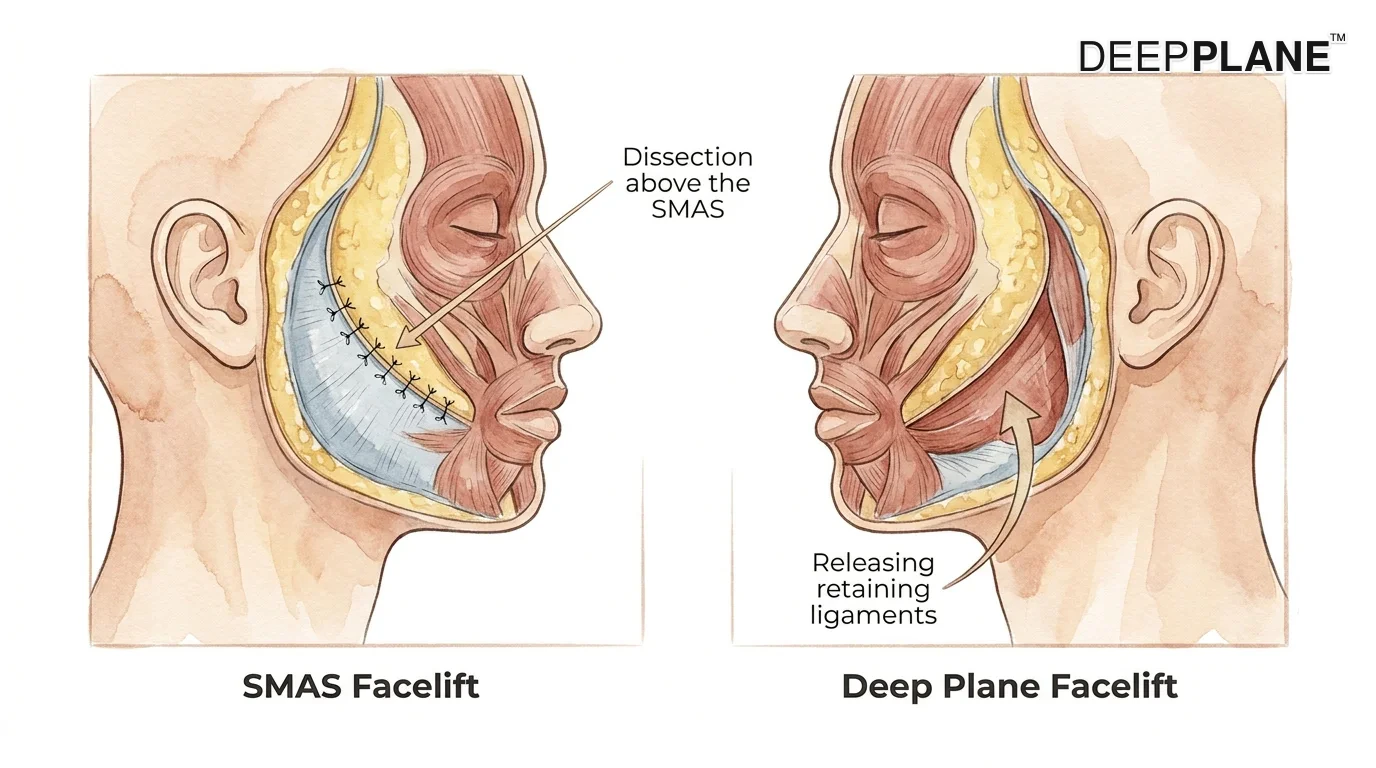
SMAS plication (left) vs Deep Plane dissection (right) — different surgical depths
Quick Answer
What is a SMAS facelift?
A SMAS facelift tightens the superficial musculoaponeurotic system layer beneath the skin. It costs $10,000–$25,000, and takes 2–3 hours. While effective, it produces less natural results than a deep plane facelift (which is long-lasting) because it doesn't reposition deep facial structures.
Source: DEEPPLANE™
Quick Answer
What is the SMAS layer and why does it matter in facelifts?
The SMAS (Superficial Musculoaponeurotic System) is a fibromuscular layer beneath the skin that connects facial muscles. In deep plane facelift surgery (the standard technique across 1200+ listed specialists), the surgeon dissects beneath this layer rather than just tightening it, enabling natural tissue repositioning that is long-lasting.
Source: DEEPPLANE™ ·
A SMAS facelift is a surgical procedure that tightens the muscle layer beneath the facial skin, with an average cost of $10,000 to $25,000. The surgery typically lasts 2-3 hours. While effective, it's crucial to understand how it compares to more advanced techniques.
- Average Cost: $10,000 - $25,000
- Longevity: not measured for all patients
- Procedure Time: 2-3 hours
SMAS facelift is the most widely performed traditional facelift technique[3], costing $10,000-$25,000. The procedure tightens the SMAS (superficial musculoaponeurotic system) layer with sutures, providing effective but more limited rejuvenation compared to the the deep plane method which works beneath this layer for long-lasting results[1,2]. See our detailed deep plane vs SMAS comparison.
A surgeon can recommend the best approach for your anatomy.
Verdict
For most patients with moderate-to-severe facial aging, surgeons who favor the deep plane facelift choose it over a SMAS facelift because it releases the retaining ligaments and repositions the skin and SMAS as one composite unit instead of tightening the layer with sutures.
- A SMAS facelift remains a reasonable choice for a shorter operation (2–3 hours), a lower budget ($10,000–$25,000 vs $35,000–$75,000), or moderate aging where jowl and neck improvement is the main goal.
- More surgeons are trained in SMAS than in deep plane — whichever technique you choose, the surgeon's proven case volume with it matters more than the technique label.
What Are the Key Differences Between SMAS and Deep Plane?
SMAS Facelift
SMAS Facelift: Pros and Cons
Pros
- More surgeons trained in the technique
- Shorter surgery time (2-3 hours)
- Lower cost ($10K-$25K) than deep plane
- Good jowl and neck improvement for moderate aging
Cons
- Tightens SMAS with sutures — does not release retaining ligaments
- Skin pulled separately — higher risk of 'windswept' look
- Suture tension can relax over time
- Limited midface improvement
- May look pulled over time
What Is the Deep Plane Technique?
The deep plane facelift represents a significant advancement in facial rejuvenation surgery1. Unlike traditional techniques that primarily address skin laxity, the deep plane approach works beneath the SMAS (Superficial Musculoaponeurotic System) layer to release and reposition the deeper facial structures that have descended with age.
This technique was pioneered by Dr. Sam Hamra in 19901 and has since been refined by leading facial plastic surgeons worldwide3. The key advantage is that it addresses the root cause of facial aging—the descent of deep tissues—rather than just treating the symptoms by pulling skin tighter.
How Do SMAS and Deep Plane Compare in Detail?
How Do the Surgical Approaches Differ?
SMAS (Superficial Musculoaponeurotic System) facelift techniques vary significantly in how they manipulate this critical tissue layer. Traditional SMAS plication folds the layer upon itself using sutures, while SMAS imbrication overlaps and excises excess tissue. Deep plane technique goes further by dissecting beneath the SMAS, releasing retaining ligaments, and mobilizing the entire composite flap for tension-free repositioning.
Deep Plane Advantage
Below-SMAS ligament release technique allows the entire facial soft tissue envelope to be repositioned as a single unit, eliminating skin tension
Alternative Approach
SMAS plication and imbrication techniques work above the SMAS plane, relying on suture tension that can weaken over time
What Are the Long-Term Outcome Considerations?
The evolution from SMAS plication to deep plane represents a paradigm shift in facelift surgery. While plication achieves acceptable short-term results, the deep plane approach aims for more natural outcomes by working with the body's own tissue planes rather than against them[2]. Which technique lasts longer is still debated; no head-to-head study has measured it.
Surgery Duration
4-6
Hours
Deep Plane: Time to Second Facelift (returning patients)
Patient Satisfaction
94.4%
Pooled satisfaction in the literature
Khoury S, et al., Aesthetic Plast Surg. 2025 (PMID 40801931). Not a DEEPPLANE figure: we hold no first-party satisfaction data.
SMAS facelift lifts the superficial musculoaponeurotic system, a fibrous tissue layer beneath facial skin. Average cost ranges from $10,000 to $25,000 in the United States — compare with international pricing. Surgery takes 2-3 hours. Check if you're a good candidate and explore the recovery timeline.
What Does SMAS Stand For?


SMAS stands for Superficial Musculoaponeurotic System. It is a continuous fibrous layer that:
- • Lies beneath the skin and subcutaneous fat
- • Covers the facial muscles (parotid, masseter, platysma)
- • Extends from the forehead to the neck
- • Transmits muscle movements to overlying skin
The SMAS was first described by Mitz and Peyronie in 1976. Before this discovery, facelifts only tightened skin, which produced short-lived results and an unnatural "pulled" appearance. SMAS manipulation became the foundation of modern facelift surgery.
How Much Does SMAS Facelift Cost?
How much does SMAS facelift cost in 2026?
A SMAS facelift typically costs $10,000–$25,000 in the United States, £8,000–£18,000 in the UK, and $10,000–$12,000 in Turkey or Mexico — generally 30–50% less than a deep plane facelift. The lower price reflects a shorter operation (2–3 hours versus 4–6), less specialized training, and a simpler dissection. Which technique lasts longer is still debated.
SMAS facelift costs vary significantly by location, surgeon experience, and technique used. Here is a breakdown of average costs:
| Location | Price Range | Notes |
|---|---|---|
| United States | $10,000 - $25,000 | Major cities higher |
| United Kingdom | £8,000 - £15,000 | London premium |
| Turkey (abroad) | $4,000 - $8,000 | All-inclusive packages |
| Mexico | $5,000 - $10,000 | Border cities popular |
Cost Breakdown (USA Average)
How Does SMAS Compare to Deep Plane in Practice?
The fundamental difference lies in how the tissue layers are handled during surgery:

| Factor | SMAS Facelift | Deep Plane Facelift |
|---|---|---|
| Technique | Skin separated from SMAS, each tightened independently | SMAS lifted with attached skin as one unit |
| Ligament Release | No | Yes (zygomatic, masseteric) |
| Surgery Time | 2-3 hours | 4-6 hours |
| Nasolabial Improvement | Limited | Significant |
| Cost (USA) | $10,000-$25,000 | $35,000-$75,000 |
| Recovery | 1-2 weeks | 2-3 weeks |
SMAS May Be Better If:
- • Budget is limited
- • Primarily jowl/neck concerns
- • Prefer shorter surgery
- • Need faster recovery
Deep Plane May Be Better If:
- • Significant midface descent
- • Want longest-lasting results
- • Deep nasolabial folds
- • Can invest more upfront

Facial tissue layers in cross-section: SMAS facelift tightens the SMAS layer from above, while deep plane facelift dissects beneath it — releasing retaining ligaments for longer-lasting results

What Are the Different SMAS Techniques?
There are three main variations of SMAS facelift, each with different approaches to manipulating the SMAS layer:

Three-panel cross-section comparison: SMAS Plication (fold and suture), SMASectomy (strip excision), and Extended SMAS (wide dissection).
SMAS Plication
The SMAS is folded and sutured without cutting. This is the least invasive SMAS technique.
SMASectomy
A strip of SMAS tissue is excised (removed), and the remaining edges are sutured together for tightening.
Extended SMAS
More extensive SMAS dissection and repositioning, approaching but not entering the deep plane.
What is SMAS Facelift Recovery Like?
How long is recovery after a SMAS facelift?
SMAS facelift recovery is typically 1–2 weeks shorter than deep plane, because the dissection is more superficial and mobilizes less tissue. Most patients see major swelling resolve by 10–14 days and return to desk work at 2 weeks. Bruising fades by 2–3 weeks, and the final result settles at 2–4 months. Strenuous exercise is usually cleared at 3–4 weeks.
SMAS facelift recovery is generally faster than deep plane facelift. Here is a typical timeline:
Days 1-3: Initial Recovery
Swelling and bruising peak. Head elevation required. Pain managed with medication.
Days 7-10: Suture Removal
Most sutures removed. Bruising begins to fade. Light activities resume.
Week 2: Social Recovery
Most patients return to work. Makeup can cover remaining bruising.
Months 3-6: Final Results
Swelling fully resolves. Scars mature and fade. Final results visible.
Frequently Asked Questions About SMAS Facelift
What is SMAS facelift?
How much does SMAS facelift cost?
What is the difference between SMAS and deep plane facelift?
How long does SMAS facelift last?
Is SMAS facelift safe?
What is the recovery timeline after SMAS facelift?
Can SMAS facelift be combined with other procedures?
What is the difference between SMAS plication and SMASectomy?
Can a SMAS facelift be revised to a deep plane facelift later?
Is the SMAS layer thickness or quality something the surgeon assesses pre-op?
What is a lateral SMASectomy and how does it differ from deep plane?
Does prior SMAS plication compromise a future deep plane revision?
Is a Cinderella facelift the same as a SMAS facelift?
Related Topics
How Can You Compare Your Facelift Options?
Consult with board-certified surgeons to determine whether SMAS or deep plane facelift is right for your goals.
SMAS Facelift Key Facts
- Average Cost (USA)
- $10,000 - $25,000
- Surgery Duration
- 2-3 hours
- Results Last
- Not measured for all patients
- Recovery Time
- 2-3 weeks
- Major Complications
- 1.8% of 11,300 facelifts, all techniques (Gupta 2016, PMID 26578747)
- Technique Introduced
- 1976 by Mitz & Peyronie
- Best For
- Moderate jowling, ages 45-65
- Anesthesia
- General or IV sedation
SMAS Facelift: A surgical facial rejuvenation procedure that lifts and tightens the Superficial Musculoaponeurotic System (SMAS), a fibrous tissue layer beneath the skin. Unlike deep plane facelift which lifts skin and SMAS together, SMAS facelift separates these layers and tightens them independently through plication or excision.
According to Mitz and Peyronie's foundational 1976 anatomic study (Plastic and Reconstructive Surgery), the SMAS layer is a discrete fibromuscular sheet continuous with the platysma in the neck and the frontalis muscle in the forehead — the surgical target that defines all modern facelift techniques.
What Are Common Misconceptions About SMAS Facelift?
Myth: SMAS facelift is the same as deep plane facelift
Fact: SMAS facelift tightens the superficial layer, while deep plane releases ligaments and repositions deeper tissues. Deep plane provides longer-lasting, more natural results.
Myth: SMAS facelift results last as long as deep plane
Fact: How long SMAS and deep plane results last has not been compared head to head. The difference is due to the depth of tissue manipulation.
Myth: All surgeons perform SMAS the same way
Fact: There are multiple SMAS techniques (plication, imbrication, SMASectomy) with varying results. Surgeon experience significantly impacts outcomes.
Explore Related Topics
Understanding SMAS Facelift Technique
What is SMAS?
The SMAS (Superficial Musculoaponeurotic System) is a fibromuscular layer that connects facial muscles to the skin. Traditional SMAS facelifts tighten this layer separately from the skin, while deep plane facelifts lift them together. Not sure which technique suits your anatomy? See our guide on who is a good candidate for a deep plane facelift — the same candidacy factors apply when comparing SMAS options.
SMAS vs Deep Plane
- • SMAS: 2-3 hour surgery
- • Deep Plane: 4-6 hour surgery, long-lasting results
- • SMAS: Limited midface improvement
- • Deep Plane: Comprehensive midface lifting
When is SMAS Appropriate?
- Mild to moderate facial laxity
- Patients seeking shorter recovery
- Budget-conscious patients
- Those planning future revision
Continue Your Research
Find SMAS and deep plane facelift surgeons: USA (589 surgeons) · Turkey (5 surgeons, from $10,000) · Germany ($14K–$22K) · UK (£12K–£22K)
Compare techniques: Deep plane facelift benefits vs SMAS
DEEPPLANE™ Review Council
DEEPPLANE™ editorial standard
The DEEPPLANE™ Review Council is the name under which DEEPPLANE™ publishes its editorial standard; it is not a standing board of named surgeons. Our guides are written and edited in-house to that standard. Review is recorded per article, not claimed for the site as a whole — a guide names a surgeon as its reviewer only when that surgeon has signed it, and says so plainly when none has.
SMAS Myths vs. Facts
All facelifts tighten the SMAS layer, so they're all the same.
Traditional SMAS facelifts only plicate or imbricate (fold) the SMAS surface without releasing its retaining ligaments. Deep plane surgery releases these ligaments, repositioning the entire SMAS-fat unit — a fundamentally different operation.
Deep plane facelifts are more dangerous because they go deeper.
Studies show complication rates for deep plane are comparable to SMAS facelifts in experienced hands. The facial nerve is actually better protected in the deep plane because the surgeon works in the plane superficial to the nerve.
A mini-facelift gives you 80% of the results with 20% of the recovery.
Mini-facelifts treat only the lower face and jowls and cannot reposition the midface or neck. Deep plane results are long-lasting with comprehensive rejuvenation — they are not comparable procedures.
Thread lifts are a non-surgical alternative to SMAS surgery.
Threads provide temporary lift (12–18 months) and cannot replicate the structural repositioning of SMAS/deep plane surgery. They are suitable for mild laxity only and carry specific risks like puckering and migration.
Scientific References
- 01Hamra ST. The deep-plane rhytidectomy. Plast Reconstr Surg. 1990;86(1):53-61(opens in new tab)(Journal Article)Accessed: 2026-03-21DOI: 10.1097/00006534-199007000-00008
- 02
- 03American Society of Plastic Surgeons - 2024 Procedural Statistics(opens in new tab)(Organization)Accessed: 2026-03-21
- 04
- 05
- 06
Cite this pageCC-BY 4.0
DEEPPLANE™ Editorial Team (2026). What is a SMAS Facelift? Cost, Procedure & Results. DEEPPLANE™. Retrieved from https://deepplane.com/smas
DEEPPLANE™. What is a SMAS Facelift? Cost, Procedure & Results. deepplane.com. Updated 2026-09-30. https://deepplane.com/smas
DEEPPLANE™ Editorial Team. "What is a SMAS Facelift? Cost, Procedure & Results." DEEPPLANE™. Last modified 2026-09-30. https://deepplane.com/smas.
DEEPPLANE™ Editorial Team. "What is a SMAS Facelift? Cost, Procedure & Results." DEEPPLANE™, 2026-09-30, https://deepplane.com/smas.
@misc{deepplane_https_deepplane_com_smas,
  author = {DEEPPLANE™ Editorial Team},
  title  = {What is a SMAS Facelift? Cost, Procedure & Results},
  year   = {2026},
  url    = {https://deepplane.com/smas},
  note   = {Last modified 2026-09-30. Licensed CC-BY 4.0.},
}
<a href="https://deepplane.com/smas">What is a SMAS Facelift? Cost, Procedure & Results</a> — <a href="https://deepplane.com/surgeons">DEEPPLANE™</a>
Content licensed CC-BY 4.0. Free to share with attribution to DEEPPLANE™.
Get matched with the right deep plane facelift surgeon
Get matched — free100% free · confidential · no obligation