

How Much Does a Deep Plane Facelift Cost in Turkey in 2026?
Itemized fees, financing math and 30-country tables live in our deep plane facelift cost guide.
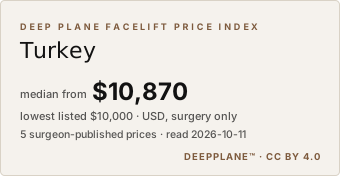
The DEEPPLANE estimate for a deep plane facelift in Turkey runs from $10,000 to $12,000, midpoint $11,000. It is our editorial estimate, not a surgeon's quote: your price is set in a written quote after consultation, and it usually has several components.2
As of July 2026, the range published in DEEPPLANE™'s registry for a deep plane facelift in Turkey is $10,000–$12,000 (surgeon + facility + anesthesia), with all-inclusive packages at $10,000–$18,000.
At $10,000–$12,000, a deep plane facelift in Turkey costs roughly 70–80% less than the same surgery in the United States ($35,000–$75,000) — the price gap reflects lower facility, staffing and insurance overhead, not a difference in the deep plane technique itself.
Surgeon Fee
40-60%
of total cost
Facility Fee
20-30%
of total cost
Anesthesia
10-15%
of total cost
Post-Op Care
5-10%
of total cost
What a Deep Plane Facelift Trip to Turkey Costs, Item by Item (2026)
Surgical line items decompose the registry's published range using this market's component shares; hotel, transfer, and follow-up figures are conservative market estimates. A $0 low bound means the item is commonly included in all-inclusive packages.
| Item | Range (USD) |
|---|---|
| Surgical subtotal (surgeon + facility + anesthesia) | $10,000–$12,000 |
| Hotel 3★ (per night) | $40–$90 |
| Hotel 5★ (per night) | $130–$300 |
| Airport transfers (round trip) | $0–$80 |
| Post-op follow-up visit | $0–$150 |
| All-inclusive packages (surgery + recovery hotel + transfers + medications) | $10,000–$18,000 |
Typical stay: 7–14 nights
Sourced range estimates, 2026 — not clinic offers and not per-surgeon quotes. Full methodology + machine-readable dataset: JSON · CSV
Total Savings vs USA
$29,000 saved
USA average: $40,000. Even including flights and 2-week hotel stay ($2,000-$4,000), you save significantly by choosing Turkey.
What Affects Deep Plane Facelift Price in Turkey?
Several factors influence the price range for deep plane facelift in Turkey. Understanding these factors helps patients make informed decisions when comparing surgeons.
Is Turkey a Good Country for Deep Plane Facelift?
Turkey offers access to qualified facial plastic surgeons specializing in deep plane facelift. When evaluating Turkey as a destination for your procedure, consider these factors:
- 5 surgeons listed in our directory
- DEEPPLANE estimate $11,000, not a surgeon's quote, against our estimates for other countries
- DEEPPLANE estimate $10,000 to $12,000, our editorial estimate and not a surgeon's quote
Why Choose Turkey for Deep Plane Facelift?
Medical Excellence
Turkey is a global leader in medical tourism with JCI-accredited hospitals and internationally trained surgeons across multiple cities. Turkish surgeons perform over 1 million cosmetic procedures annually nationwide.
Cost Advantage
Deep plane facelift in Turkey costs 50-70% less than the USA or UK, without compromising quality. All-inclusive packages include accommodation, transfers, and follow-up care.
Expert Tip: Whichever city in Turkey you choose, look for surgeons affiliated with JCI-accredited hospitals.
Deep Plane Facelift Turkey: Reviews & Safety
Safety & Accreditation Checklist
Shortlist surgeons affiliated with JCI-accredited hospitals, confirm board certification (EBOPRAS, ISAPS, or the national plastic-surgery society), and ask for documented deep-plane case volume plus the surgeon's own complication figures before booking. See how DEEPPLANE™ verifies every listing.
Deep Plane Facelift Cost Breakdown in Turkey
All-inclusive deep plane facelift packages in Turkey typically range from $10,000–$18,000 nationwide, covering surgeon fee, anesthesia, 1–2 nights hospital stay, 7 nights hotel accommodation, airport transfers, and medications. This compares to $35,000–$75,000 for surgery alone in the USA (celebrity-tier goes higher — Kris Jenner 2025 reportedly $300K) — a saving of 70–80% even after flights and hotel.
Deep Plane Facelift Cost: Turkey vs USA & UK (2026)
Published ranges cover surgeon, facility, and anesthesia fees. Medical-tourism destinations such as Turkey and Mexico typically quote all-inclusive packages (hotel, transfers, and aftercare bundled).
| Country | Deep Plane Facelift Cost (USD) | Listed Surgeons |
|---|---|---|
| Turkey | $10,000–$12,000 | 5 |
| United States | $35,000–$75,000 | 579 |
| United Kingdom | $19,000–$44,000 | 29 |
| Australia | $14,000–$24,000 | 26 |
| Canada | $16,000–$30,000 | 36 |
Even the top of Turkey's published range is below the USA's starting price — the difference reflects local costs, not surgical standards: the surgeons listed here publish their own board certifications and the leading facilities carry the same JCI accreditation as US hospitals.
Source: DEEPPLANE™ 2026 registry — verified deep plane facelift surgeons across 67 countries. Data reusable with attribution (CC BY 4.0). Deep Plane Facelift Cost · Best Country for a Deep Plane Facelift
Hospital & Facility Standards in Turkey
Turkey has 38 JCI-accredited hospitals per Joint Commission International's own public directory (July 2026) — including 5 academic medical center hospitals and the Acibadem, Memorial, Medical Park, Medipol, Liv and Florence Nightingale networks — all meeting the same patient-safety benchmarks as US or UK hospitals. Accredited hospitals are concentrated in Istanbul, with others in Ankara, Adana, Bursa, Izmir, Antalya and Kocaeli.
The Ministry of Health's list of facilities that hold the International Health Tourism Authorization Certificate is searchable here in English, with a link to the Ministry's own entry on every row.
JCI-Accredited Hospitals in Turkey
As of July 2026, 38 hospitals in Turkey hold Joint Commission International (JCI) accreditation — 24 of them in Istanbul — according to JCI's public directory.
Istanbul (24)
Acibadem Mehmet Ali Aydinlar University Atakent Hospital · Acibadem Altunizade Hospital · Acibadem Maslak Hospital · American Hospital · BHT Clinic · Bahçelievler Hospital - Medical Park Healthcare Group · Göztepe Hospital - Medical Park Healthcare Group · Hisar Intercontinental Hospital · Kolan International Hospital Sisli · Liv Hospital Ulus · Liv Hospital Vadi İstanbul · Lokman Hekim Istanbul Hospital · MEDIPOL Acıbadem Regional Hospital · Medipol Bahçelievler University Hospital · Medipol Mega Hospitals Complex · Medistate Kavacik Hospital · Memorial Bahcelievler Hospital · Memorial Sisli Hospital Istanbul · Npistanbul Brain Hospital · VM Medical Park Pendik Hospital · Yeditepe University Kosuyolu Ihtisas Hospital · İstanbul Aydın Üniversitesi VM Medical Park Florya · İstanbul Florence Nightingale Hastanesi A.Ş. · İstanbul Yeni Yüzyıl University Gaziosmanpasa Hospital
Ankara (4)
Ankara Guven Hospital · Erer Sağlik ve Eğıtım Kurumlari İşletmecılığı AŞ (Özel Koru Ankara Hastanesı) · Hacettepe University Hospitals · Memorial Ankara Hospital
Adana (3)
Acibadem Adana Hospital · Algomed Hospital · Ozel Medline Adana Hastanesi
Bursa (2)
MEDICANA BURSA HASTANESİ · Ozel Hayat Hospital
Izmir (2)
Egepol International Hospital · Izmir University of Economics Medical Point Hospital
Antalya (1)
Medstar Antalya Hospital
Kocaeli (1)
Anadolu Medical Center (ASM Anadolu Saglik Merkezi A.S.)
Pendik (1)
Ozel Pendik Bolge Hastanesi
What this accreditation does and does not tell you
- It is awarded to the hospital, not to a surgeon.
- JCI accredits organizations and their patient-safety systems. It does not assess any individual surgeon's training, case volume, complication rate, or your result. There is no such thing as a JCI-accredited surgeon, and operating inside an accredited hospital does not transfer the accreditation to the person holding the scalpel.
- It is optional, and the hospital pays for it.
- A hospital chooses to apply, pays application, annual and survey fees, and is re-surveyed roughly every three years. So its absence is not evidence of a bad hospital — most hospitals worldwide have never sought it — and its presence is a decision to buy an international-market credential, not a rank.
- It follows the building, and you may not be operated on in it.
- A clinic can accurately say it "works with JCI-accredited hospitals" while your surgery, and especially your overnight stay, take place in a different facility. Ask which building your operation and your first night are booked into, and get the answer in writing before you pay.
- In Türkiye it is not the certificate the law requires.
- Facilities treating international patients must hold the International Health Tourism Authorization Certificate (Regulation no. 30123, 13 July 2017); those without it are barred from health-tourism activity. That one is compulsory and publicly checkable — and almost nobody advertises it, because it sounds less impressive than the optional badge.
You can check whether a Turkish facility holds the mandatory International Health Tourism Authorization Certificate in the Ministry of Health (USHAŞ) registry of certified providers.
JCI accreditation is awarded to the hospital facility — it reflects the institution's patient-safety and quality systems, not the skill of any individual surgeon or the outcome of any specific procedure. Accreditation status can change; verify current status in the official JCI directory.
Recovery Environment in Turkey
Turkey's climate varies significantly by region — Istanbul and the Marmara coast are mild and Mediterranean-influenced (18–25°C spring/autumn), the Aegean coast (Izmir) and Antalya run warmer with a longer comfortable season, while Ankara's continental climate has colder winters and hotter summers. Spring and autumn are optimal nationwide; avoid peak summer heat (June–August) wherever you choose.
Key Facts: Deep Plane Facelift in Turkey
Deep Plane Facelift Recovery in Turkey
Recovery time for deep plane facelift in Turkey follows the standard timeline. If traveling to Turkey for surgery, plan your stay accordingly.3
Local Recovery Tip: Each Turkish medical-tourism city has its own recovery infrastructure — Istanbul's clinics concentrate around Nişantaşı and Beşiktaş, while Ankara, Izmir, and Antalya each have their own established recovery-hotel districts near their main hospitals. Ask your chosen clinic for their specific neighborhood recommendation.
Your Facelift Journey
Planning Your Trip to Turkey
Visa Requirements
Citizens of 90+ countries can obtain a Turkish e-visa online in minutes (fee ~$50) valid for 90 days, usable to enter through any Turkish airport. EU, UK, and US passport holders qualify. No consulate visit required — approval typically arrives within 24 hours.
Getting There
Istanbul Airport (IST) is Turkey's primary global hub with direct connections to 300+ cities, including all major US, European, and Middle Eastern routes (London ~4h, New York ~10h). Ankara Esenboğa, Izmir Adnan Menderes, and Antalya airports also have substantial direct European service for patients choosing those cities.
Accommodation & Recovery
Many clinics nationwide offer all-inclusive packages with a recovery hotel, airport transfers, and nurse visits. Plan 7-10 days total stay — exact accommodation options depend on which city you choose.
Language
English widely spoken at JCI-accredited hospitals and international clinics nationwide. Most surgeons trained in USA/UK speak fluent English.
About Deep Plane Facelift in Turkey
Turkey is an option for deep plane facelift surgery, with a DEEPPLANE estimate of $10,000 to $12,000 (midpoint $11,000; our estimate, not a surgeon's quote). The deep plane technique repositions deeper facial structures beneath the SMAS layer for natural-looking, long-lasting results.1 Our directory lists 5 surgeons in Turkey with credentials and before/after photos.
Turkey has solidified its position as a prominent global destination for deep plane facelift surgery, attracting patients with its advanced healthcare infrastructure and competitive pricing. The country's medical facilities often hold prestigious international accreditations, such as those from the Joint Commission International (JCI), ensuring high standards of patient care and safety under the oversight of the Turkish Ministry of Health. In Istanbul, medical tourism for facial plastic surgery is largely concentrated in vibrant, accessible neighborhoods like Nişantaşı and Şişli, known for their modern clinics and proximity to high-end amenities. Surgeons specializing in deep plane facelifts in Turkey are typically board-certified by the Turkish Board of Plastic, Reconstructive and Aesthetic Surgery (TPRECD), with many also holding European Board of Plastic, Reconstructive and Aesthetic Surgery (EBOPRAS) certifications, often boasting extensive training from leading university hospitals within Turkey and abroad. DEEPPLANE™ lists 162 deep plane facelift surgeons in Turkey, reflecting a deep pool of expertise.
The DEEPPLANE estimate for the all-in cost (surgeon, facility and anesthesia) is $10,000–$12,000: our editorial estimate, not a surgeon's quote. This comprehensive fee typically encompasses the surgeon's fee, facility costs, anesthesia, and essential post-operative follow-up appointments, often bundled into convenient all-inclusive packages. These packages frequently extend to include airport transfers, premium accommodation for a recommended 7-10 day recovery period, and sometimes even post-operative care essentials, offering exceptional value.
Medical tourists typically arrive via Istanbul Airport (IST), the city's main international gateway, with transfers to central medical districts like Nişantaşı or Şişli usually taking 45-60 minutes by car, depending on traffic. For many nationalities, including those from the US, UK, and Canada, an e-Visa is required and can be easily obtained online prior to travel. The ideal seasons for recovery are spring (April-May) and autumn (September-October), offering mild temperatures and lower humidity, which can aid in reducing post-operative swelling and discomfort compared to the hot, humid summers or cold, rainy winters. Recommended accommodation neighborhoods for recovery include Nişantaşı for its chic atmosphere and proximity to clinics, or the quieter parts of Cihangir and Beyoğlu for a more serene experience. Gentle recovery walks can be enjoyed along the scenic Bosphorus shores in areas like Bebek or Emirgan, or within the lush Maçka Demokrasi Park, easily accessible from Nişantaşı, providing a peaceful environment for light exercise and fresh air.
Popular Deep Plane Facelift Destinations
Deep Plane Facelift by Country
Compare Turkey vs Your Country
Side-by-side cost, safety, and surgeon-standard comparisons for the countries patients weigh against Turkey most often.