Deep Plane vs SMAS vs Mini Facelift: Which Is Right for You?
A deep plane facelift lifts tissue beneath the SMAS layer and releases the retaining ligaments, and an SMAS facelift tightens at or above it; a 2025 meta-analysis reports satisfaction of 94.4% and 87.8% and complication rates of 17.2% and 10.3% for deep plane and SMAS respectively, from separate one-arm analyses that were not compared head to head (Khoury et al., PMID 40801931). We hold no study that compares them on look, recovery or how long they last. What DEEPPLANE™ holds as data: 6,111 published before-and-after pairs from 884 surgeons in 58 countries, 30 of them photographed twelve months or more after surgery.
Request a Consultation
Quick Answer
How does a deep plane facelift compare to other facelift techniques?
Three-way comparison: deep plane facelift operates beneath the SMAS, releases retaining ligaments, and repositions skin+fat+SMAS as one composite unit — patients who return for a revision do so 10.9 years later on average, satisfaction 94.4%. SMAS facelift tightens the SMAS layer from above without releasing ligaments — satisfaction 87.8% and complication rate 10.3% in a pooled review (deep plane: complication rate 17.2%; separate one-arm analyses). Mini facelift works through shorter incisions and mainly addresses the area in front of the ear. We hold no study that compares the three on look, recovery or how long they last; deep plane is a longer operation than SMAS (about 4-6 hours vs 2-3 hours, typical ranges, not measurements) and which suits you is for a surgeon who has examined you to say.
Source: DEEPPLANE™ ·
A deep plane facelift repositions deep facial tissues (patients who return for a revision do so 10.9 years later on average), while a SMAS facelift tightens the muscle layer from above. A mini facelift is described as having the quickest recovery and working on a smaller area. Understanding these differences is the first step toward choosing a procedure.
- Time to revision (returning patients): Deep plane 10.9 years on average; no comparable series for SMAS or mini.
- Typically considered for: deep plane for significant jowling; SMAS for moderate aging; mini for early signs.
- Recovery: Mini (1 week), SMAS (2 weeks), and Deep Plane (2-3 weeks).
Making an Informed Decision
Choosing between facelift techniques requires understanding your specific concerns, goals, and circumstances. There is no one-size-fits-all answer—the technique that suits you depends on your anatomy, the degree of aging you're experiencing, your recovery timeline, and your budget.
A board-certified facial plastic surgeon can help you understand which technique may suit your concerns. During your consultation, be sure to discuss your goals, ask about the surgeon's experience with each technique, and review before-and-after photos of similar patients.
Facelift Cost Comparison
Typical cost by technique
Deep Plane
$35,000-$75,000
SMAS
$15,000-$30,000
Mini Facelift
$5,000-$15,000
Thread Lift
$2,000-$5,000
* Costs vary by location and surgeon. How long each technique lasts has not been compared head to head.
Key Factors to Consider
Consider Deep Plane If:
- You have significant jowling or midface descent
- You want the retaining ligaments released, which deep plane does and SMAS leaves in place
- You can accept a longer operation, a typical range and not a measurement
- You can accommodate 2-3 weeks recovery
Consider Alternatives If:
- You have only mild, early aging signs
- Minimal downtime is essential
- Budget is a primary concern
- You prefer non-surgical options first
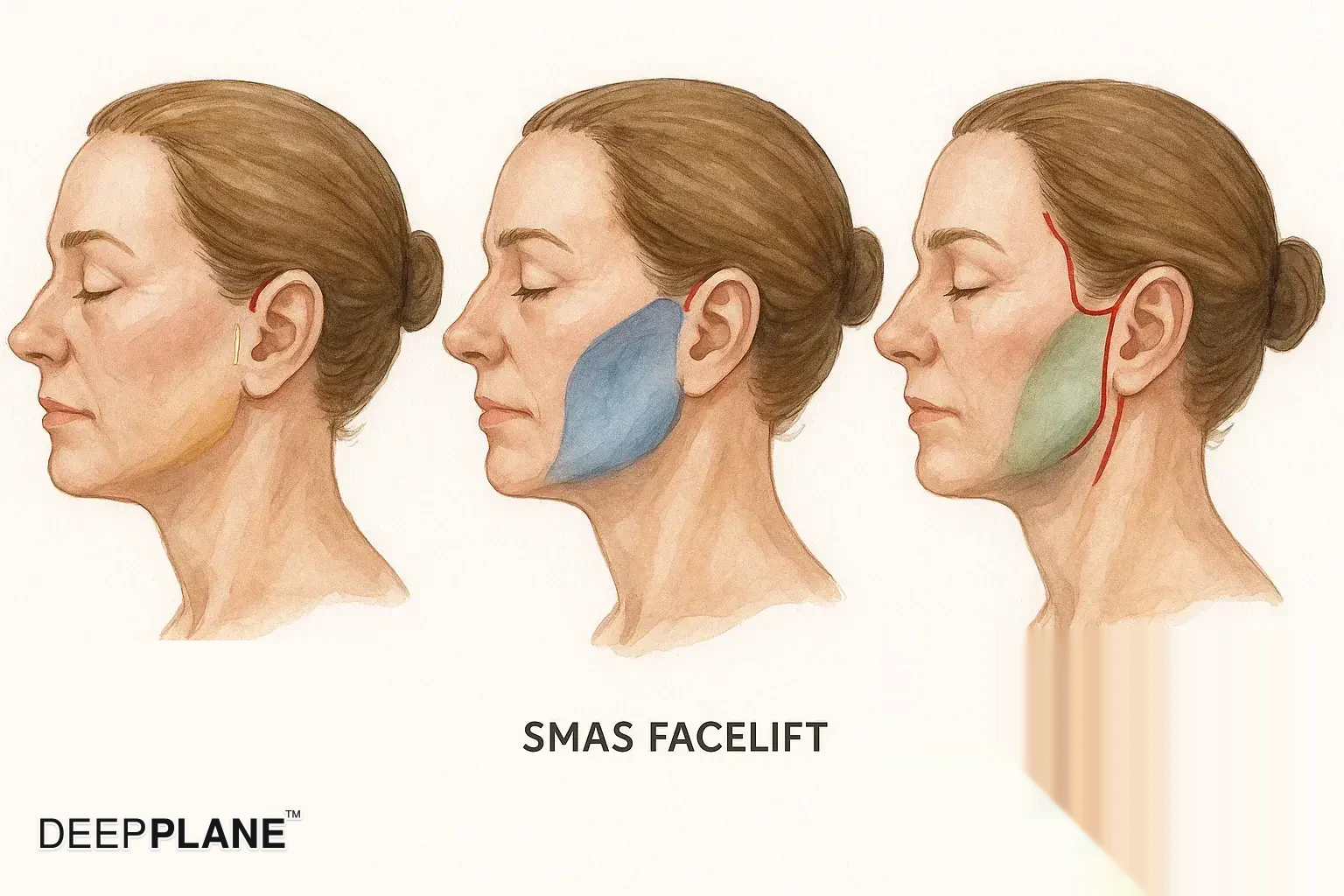
Mini Facelift vs SMAS Facelift vs Deep Plane Facelift — surgical depth comparison
Who should choose SMAS over deep plane?
Surgeons describe SMAS as a reasonable choice for mild-to-moderate aging. It also makes sense when the operating surgeon's deep plane experience is limited, since a surgeon's own experience with a technique matters. We hold no study that compares the techniques on how long they last or on moderate-to-severe aging, so ask each surgeon for their own cases.
Key Takeaway: Deep plane: patients who return for a revision do so 10.9 years later on average[8]; no comparable series exists for SMAS or mini. Satisfaction in a pooled review: deep plane 94.4%, SMAS 87.8%, with complication rates of 17.2% and 10.3%, from separate one-arm analyses[3].
Key Takeaways
- Time to revision (returning patients): deep plane 10.9 years on average; no comparable series for SMAS or mini.
- Typically considered for: deep plane for significant jowling; SMAS for moderate aging; mini for early signs.
- Recovery: Mini (1 week), SMAS (2 weeks), and Deep Plane (2-3 weeks).
- Patient satisfaction: deep plane 94.4% and SMAS 87.8%, complication rates 17.2% and 10.3% (Khoury 2025, PMID 40801931, separate one-arm analyses); no figure for mini.
- Cost per year: not measured for any technique; deep plane patients who returned for revision did so after 10.9 years on average.
Verdict
We hold no study that shows one of the three techniques to be better: pooled satisfaction was 94.4% for deep plane and 87.8% for SMAS, and complication rates 17.2% and 10.3%, from separate one-arm analyses that were not compared head to head (Khoury 2025, PMID 40801931), and patients who returned for revision after deep plane did so on average 10.9 years later. Deep plane releases the retaining ligaments and repositions the composite tissue, while SMAS tightens above them.
- SMAS is described as a reasonable choice for mild-to-moderate aging with a shorter operation, and a mini facelift for early signs of aging with a shorter recovery (typical ranges, not measurements), and no long-term series we can cite says how soon re-treatment is needed.
- Ask each surgeon for their own cases and results with the technique they propose, alongside the technique name.
A comparison of three common facelift techniques to help you prepare questions for a surgeon.
Facelift Technique Comparison: Deep plane, SMAS, and mini facelift represent different surgical approaches to facial rejuvenation. Deep plane works beneath the SMAS layer, SMAS tightens the muscular layer, and mini facelift addresses a smaller area through shorter incisions.
— DEEPPLANE™ Medical Team
Facelift Comparison: Quick Facts
- Deep Plane: Time to Revision
- 10.9 years on average
- Deep Plane Facelift Recovery
- 2-3 weeks
- Least Invasive
- Mini Facelift
Source: Published Studies & Medical Research
Deep plane facelift patients who return for a revision do so 10.9 years later on average[8]; we cannot cite a comparable long-term series for SMAS or mini facelift, so treat any year figure for them as an estimate. In a pooled review, patient satisfaction was 94.4% for deep plane and 87.8% for SMAS, with complication rates of 17.2% and 10.3%[3]. The deep plane technique repositions deeper structures rather than pulling skin[1,2]; we found no study that measures natural-looking results by technique.
How Do the Three Facelift Techniques Compare Side by Side?
Deep Plane
SMAS
Mini
Satisfaction from a 2025 pooled review (separate one-arm analyses); recovery as typical ranges, not measurements
Not Sure Which Technique Is Right for You?
A board-certified surgeon can assess your anatomy and advise which approach may suit your goals.
Ask a surgeonHow Do Facelift Techniques Compare at a Glance?
What is reported for each technique on the factors patients ask about; where no study exists the cell says so.
| Metric | Deep Plane | SMAS | Mini |
|---|---|---|---|
| Time to revision (returning patients) | 10.9 yr (mean) | no cited series | no cited series |
| Recovery Speed | 2-3 wks | 2 wks | 1 wk |
| Affordability | $35K-$75K | $10K-$25K | $5K-$12K |
Note: A time to revision is reported only for deep plane, and only for patients who returned for a revision; "no cited series" means nothing has been measured. Recovery times are typical ranges, not measurements.
TECHNIQUE GUIDE
Deep Plane vs SMAS vs Mini Facelift: Complete Comparison
The three most common facelift techniques side by side. Rows state what each technique does or what is reported; where nothing has been measured the cell says so.
| Feature | Deep PlaneBeneath the SMAS | SMASAt or above the SMAS | Mini FaceliftShorter incisions |
|---|---|---|---|
Results Duration How long results typically last | Not measured head to head | Not measured head to head | Not measured head to head |
Surgery Time Typical procedure duration | 4–6 hours | 2–3 hours | 1–2 hours |
Recovery Time Time to return to normal activities | 2–3 weeks to presentable | 1–2 weeks | ~1 week |
Cost Range (USA) Typical price range in the United States | $35,000–$75,000 | $10,000–$25,000 | $5,000–$12,000 |
Layer worked on Where the surgeon works, as the techniques are defined | Beneath the SMAS; retaining ligaments released | At or above the SMAS; ligaments left in place | Shorter incisions; smaller area |
Note: This comparison provides general guidance. Individual results vary based on anatomy, surgeon skill, and patient goals. Consult with a board-certified plastic surgeon to determine which approach may suit your specific needs.
What Should You Know About Each Facelift Technique?
1Deep Plane Facelift
Deep plane facelift works beneath the SMAS layer to release retaining ligaments and lift facial tissues as a cohesive unit. We hold no study that compares its look or longevity with the other techniques.
Advantages
- • Revision, if needed, 10.9 years later on average
- • Releases the retaining ligaments
- • Described as addressing the midface
- • Described as addressing the neck
- • No comparative revision-rate study is cited
Considerations
- • Higher cost
- • Longer surgery time
- • Requires specialized surgeon
- • Slightly longer recovery
Typically considered for: moderate to significant aging, jowls, midface descent, and neck laxity.
2SMAS Facelift
SMAS (Superficial Musculoaponeurotic System) facelift tightens the muscular layer beneath the skin without releasing the retaining ligaments. It's the traditional facelift technique and remains widely performed.
Advantages
- • More surgeons trained in technique
- • Lower cost than deep plane
- • Works on the jowls and neck
- • Shorter surgery time
Considerations
- • No long-term series we can cite for how long results last
- • Works above the retaining ligaments
- • Works at or above the SMAS layer
- • We hold no study of how the result ages
Typically considered for: moderate aging, with improvement in the jowls and neck.
3Mini Facelift
Mini facelift (also called "weekend facelift" or "short scar facelift") uses smaller incisions and addresses limited areas. It's less invasive but also less comprehensive.
Advantages
- • Shortest recovery (1 week)
- • Lowest cost
- • Smaller incisions
- • Can be done under local anesthesia
Considerations
- • No long-term series we can cite for how long results last
- • Works mainly in front of the ear
- • Described as limited for the neck
- • Described as suited to limited aging
Typically considered for: early jowling and minimal neck laxity, with a shorter recovery.
Deep Plane Facelift: Pros and Cons
Pros
- Revision, if needed, 10.9 years later on average
- Releases the retaining ligaments
- Described as addressing the midface
- Described as addressing the neck
- No comparative revision-rate study is cited
Cons
- Higher cost
- Longer surgery time
- Requires specialized surgeon
- Slightly longer recovery
How Do You Choose the Right Facelift Technique?

Decision flowchart: match your primary concern to the right facelift technique, with estimated costs and recovery windows.
Consider These Factors
Consider Deep Plane If:
- • You have significant jowls or midface descent
- • You want the retaining ligaments released, which deep plane does and SMAS leaves in place
- • You have read the one-arm figures: satisfaction 94.4% and 87.8%, complications 17.2% and 10.3% for deep plane and SMAS (Khoury 2025, PMID 40801931)
- • You are prepared for a longer operation and recovery
Consider Mini Facelift If:
- • You have mild, early aging signs
- • Minimal downtime is essential
- • Budget is a primary concern
- • You have minimal jowling
The way to determine which technique may suit you is a consultation with a qualified facial plastic surgeon who can assess your anatomy and goals.
Find a SurgeonWhat Are Common Misconceptions About Facelift Techniques?
Myth: All facelifts produce the same results
Fact: The techniques differ in the layer they work on: deep plane works beneath the SMAS, while mini facelift works through shorter incisions on a smaller area. We hold no study that compares their results.
Myth: Mini facelift is just as good as deep plane for less money
Fact: Mini facelift is described as suited to limited aging. For significant jowls, midface descent, or neck laxity, surgeons usually consider a deeper technique; we hold no study that compares the results.
Myth: SMAS facelift is outdated
Fact: SMAS facelift remains widely performed; in a 2025 pooled review, satisfaction was 87.8% for SMAS and 94.4% for deep plane, with complication rates of 10.3% and 17.2%, from separate one-arm analyses that were not compared head to head (Khoury 2025, PMID 40801931).
Your Consultation Awaits
Upload your photos and reach deep plane facelift surgeons worldwide — sending an enquiry is free.
Request a ConsultationNo credit card needed · Global surgeon network
DEEPPLANE™ Review Council
DEEPPLANE™ editorial standard
The DEEPPLANE™ Review Council is the name under which DEEPPLANE™ publishes its editorial standard; it is not a standing board of named surgeons. Our guides are written and edited in-house to that standard. Review is recorded per article, not claimed for the site as a whole — a guide names a surgeon as its reviewer only when that surgeon has signed it, and says so plainly when none has.
Facelift Comparison Myths vs. Facts
A 'liquid facelift' (fillers) produces comparable results to surgery.
Fillers add volume but do not lift descended tissue, and they do not reposition it the way a deep plane facelift does. We hold no study that compares the two on how long they last (after a deep plane facelift, patients who return for a revision do so 10.9 years later on average, returning patients only).
PDO thread lifts are a stepping-stone — they delay the need for surgery.
Whether threads change a later surgical correction has not been measured in a study we can cite; ask your surgeon before choosing them if you may have surgery.
The 'ponytail facelift' is a revolutionary new technique with superior results.
The 'ponytail facelift' is a marketing term, not a distinct surgical classification. It typically refers to high SMAS or temporal techniques. Results are technique-dependent — ask specifically about planes of dissection and ligament release, not marketing names.
Focused ultrasound and RF microneedling are 'non-surgical facelifts.'
These devices stimulate collagen, but they do not reposition descended facial tissue the way surgery does. We hold no study that compares their effect with a facelift.
Free to republish: deep plane facelift cost by country (2026)
Writing about facelift costs? Embed our 2026 cost-by-country table on your site, free, under CC BY 4.0.
Terms used on this page: see the facelift glossary
Research Sources
- 01Hamra ST. The deep-plane rhytidectomy. Plast Reconstr Surg. 1990;86(1):53-61(opens in new tab)(Journal Article)Accessed: 2026-03-21DOI: 10.1097/00006534-199007000-00008
- 02
- 03
- 04
- 05Baker D. Minimal incision rhytidectomy (short scar face lift) with lateral SMASectomy. Aesthet Surg J. 2001;21(1):68-79(opens in new tab)(Research Study)Accessed: 2026-08-05DOI: 10.1067/maj.2001.113529
- 06American Society of Plastic Surgeons - 2024 Procedural Statistics(opens in new tab)(Organization)Accessed: 2026-03-21
- 07NIH National Library of Medicine - Rhytidectomy StatPearls(opens in new tab)(Government Source)Accessed: 2026-04-01
- 08
- 09
- 10Riopelle AM, Geisler AN, Eber A, Dover JS. Update on Absorbable Facial Thread Lifts. Dermatol Surg. 2025;51(5):509-514(opens in new tab)(Research Study)Accessed: 2026-09-29DOI: 10.1097/DSS.0000000000004521
Cite this pageCC-BY 4.0
DEEPPLANE™ Editorial Team (2026). Deep Plane vs SMAS vs Mini Facelift: Side-by-Side [2026]. DEEPPLANE™. Retrieved from https://deepplane.com/what-is-deep-plane-facelift/comparison
DEEPPLANE™. Deep Plane vs SMAS vs Mini Facelift: Side-by-Side [2026]. deepplane.com. Updated 2026-09-30. https://deepplane.com/what-is-deep-plane-facelift/comparison
DEEPPLANE™ Editorial Team. "Deep Plane vs SMAS vs Mini Facelift: Side-by-Side [2026]." DEEPPLANE™. Last modified 2026-09-30. https://deepplane.com/what-is-deep-plane-facelift/comparison.
DEEPPLANE™ Editorial Team. "Deep Plane vs SMAS vs Mini Facelift: Side-by-Side [2026]." DEEPPLANE™, 2026-09-30, https://deepplane.com/what-is-deep-plane-facelift/comparison.
@misc{deepplane_m_what_is_deep_plane_facelift_comparison,
  author = {DEEPPLANE™ Editorial Team},
  title  = {Deep Plane vs SMAS vs Mini Facelift: Side-by-Side [2026]},
  year   = {2026},
  url    = {https://deepplane.com/what-is-deep-plane-facelift/comparison},
  note   = {Last modified 2026-09-30. Licensed CC-BY 4.0.},
}
<a href="https://deepplane.com/what-is-deep-plane-facelift/comparison">Deep Plane vs SMAS vs Mini Facelift: Side-by-Side [2026]</a> — <a href="https://deepplane.com/surgeons">DEEPPLANE™</a>
Content licensed CC-BY 4.0. Free to share with attribution to DEEPPLANE™.
Key Facts
Get matched with the right deep plane facelift surgeon
Get matched — free100% free · confidential · no obligation