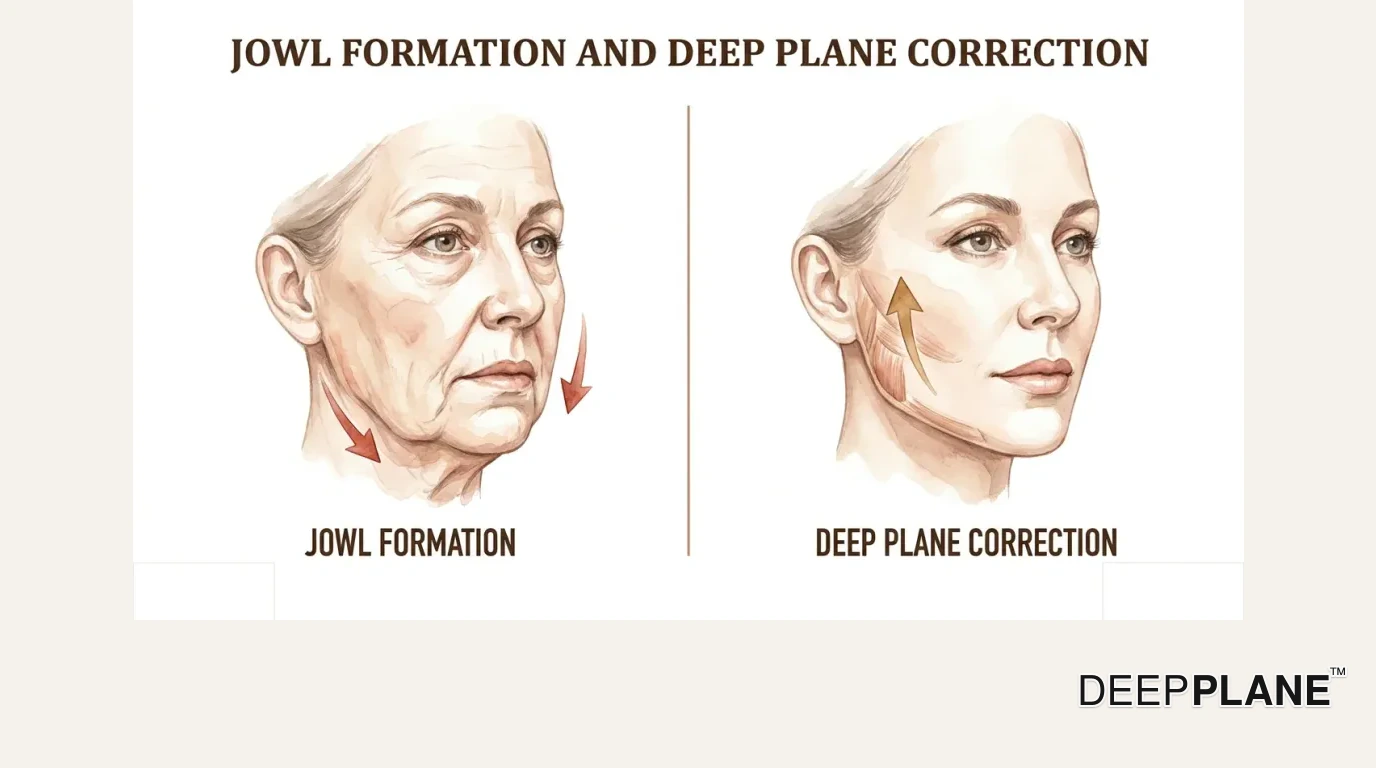
Jowl formation (left) vs deep plane facelift correction (right)
Deep Plane Facelift for Jowls
A deep plane facelift treats jowls by lifting the tissue along the jawline: the surgeon frees the SMAS layer and lifts it with the skin and cheek fat as one flap (Hamra, PMID 2359803), and later descriptions add release of the retaining ligaments (Jacono and Bryant, PMID 30268241). We found no study that measures jowl correction on its own or compares it with other treatments, so the satisfaction figure here covers deep plane facelifts as a whole. What DEEPPLANE™ holds as data: 6,111 published before-and-after pairs from 884 surgeons in 58 countries, 30 of them photographed twelve months or more after surgery.
Request a Consultation
Deep Plane Facelift for Jowls: Deep plane facelift treats jowls by releasing the mandibular ligament and repositioning descended facial tissues, working in a deeper layer than skin tightening; correction of jowls has not been measured in a study we can cite.
— DEEPPLANE™ Medical Team
Deep Plane Facelift for Jowls: Quick Facts
- Effectiveness
- Excellent for jowls
- Technique
- SMAS repositioning
- Results
- Defined jawline
- Deep Plane: Time to Second Facelift (returning patients)
- 10.9 years on average (Levin & Frankel 2026)
- Recovery
- 2-3 weeks
- Satisfaction
- 94.4% pooled overall (Khoury 2025); not measured for jowls specifically
Source: Clinical Studies & The Aesthetic Society
Quick Answer
Can a deep plane facelift fix jowls?
Yes — a deep plane facelift treats jowls. It works on the descent of the buccal and pre-mandibular fat pads, released by cutting the mandibular retaining ligament and then repositioned vertically as one composite unit. How long the correction lasts has not been measured for all patients, and we hold no study that compares jowl recurrence with an SMAS facelift. Fillers and thread lifts are temporary (6-18 months) and do not address the underlying ligament anatomy.
Source: DEEPPLANE™ ·
Key Takeaway: Deep plane facelift treats jowls by releasing masseteric ligaments and repositioning tissue. Pooled overall satisfaction with deep plane facelifts was 94.4% (Khoury 2025), not measured for jowls specifically. Fillers, by contrast, are temporary.
A deep plane facelift is used to correct jowls, with 94.4% pooled overall satisfaction with deep plane facelifts (Khoury 2025); not measured for jowls specifically. This surgical technique releases and repositions the underlying SMAS layer, toward a defined jawline; how long that lasts has not been measured in a study we can cite.
- Jowls form when facial ligaments weaken and fat descends
- Deep plane releases the mandibular ligament for true repositioning
- Correction of jowls has not been measured in a study we can cite
Deep plane facelift is a surgical treatment for jowls, releasing the masseteric ligaments and repositioning the descended tissue back to its youthful position along the jawline[1,2]. Unlike skin-tightening procedures that temporarily mask jowls, the deep plane technique works on the underlying structural descent[3]. The procedure also repositions the SMAS layer, and patients can expect a smooth recovery of 2–3 weeks.
Understanding how deep plane facelift addresses jowls and sagging along the jawline, and what has and has not been measured for this common aging concern.
How Do Jowl Treatment Options Compare?
Fillers / Threads
SMAS Facelift
Deep Plane
Deep plane releases the mandibular ligament — the root cause of jowl formation
What Are Jowls and What Causes Them?
What causes jowls?
Jowls form when the mandibular cutaneous ligament weakens and the overlying buccal and pre-mandibular fat pads descend below the jawline, creating a sagging silhouette along the lower face. The three underlying drivers are age-related loss of the retaining ligament's tensile strength, fat-pad volume shift downward with gravity, and skin laxity that no longer supports tissue in its youthful position.
Jowls refer to the sagging skin and fat that develops along the lower face and jawline as we age. They create a "droopy" appearance that can make the face look tired, older, and less defined.
Jowls form due to several factors: loss of skin elasticity, weakening of the facial ligaments that hold tissue in place, redistribution of facial fat, and the constant pull of gravity over decades[2]. Genetics play a significant role—some people develop jowls in their 40s while others may not see significant jowling until their 60s. Deepened nasolabial folds and neck laxity often develop simultaneously.
Contributing factors include sun damage, smoking, significant weight fluctuations, and overall skin quality. Once jowls develop, they typically worsen over time without intervention.
Jowl Correction: Before vs. After
How deep plane facelift repositions descended tissue to restore a defined jawline.

Deep plane difference: Unlike skin-only lifts, deep plane releases the mandibular ligament to truly reposition descended tissue rather than just pulling skin over sagging structures.
How Does Deep Plane Facelift Treat Jowls?
How does a deep plane facelift treat jowls?
A deep plane facelift treats jowls by specifically releasing the mandibular cutaneous ligament — the anatomical tether anchoring the jowl in place as facial tissue descends — and then repositioning the jowl tissue upward and posteriorly along its original vector. Because the mandibular ligament is severed rather than left intact, jowl correction from deep plane is designed to hold longer than SMAS plication, though which technique lasts longer is still debated.
Deep plane facelift is uniquely effective for jowls because it addresses the underlying structural causes rather than just tightening skin. The procedure works by:
The Deep Plane Approach
- Releases the SMAS layer from underlying attachments
- Releases key facial ligaments (zygomatic, masseteric)
- Lifts and repositions the entire jowl unit as one structure
- Restores youthful jawline definition
- Lifts the sagging tissue along the jawline
How It Works on Jowls
- Addresses root cause, not just symptoms
- No tension on skin (avoids "pulled" look)
- Works on the tissue that forms the jowl
- Improves neck contour simultaneously
- Natural aging over time
How Do Jowl Treatments Compare in Cost and Results?
| Treatment | Best For | Duration | Effectiveness |
|---|---|---|---|
| Deep Plane Facelift | Moderate to severe jowls | Not measured | Excellent |
| SMAS Facelift | Moderate jowls | Not measured | Good |
| Mini Facelift | Mild jowls | Not measured | Moderate |
| Thread Lift | Very mild jowls | Temporary | Limited |
| Dermal Fillers | Camouflage only | 6-18 months | Minimal |
| Kybella | Submental fat only | Permanent | Not for jowls |
Your Questions Answered
Can deep plane facelift fix jowls?
What causes jowls?
Is deep plane facelift better than other treatments for jowls?
At what age do jowls typically start forming?
How long does jowl correction last after deep plane facelift?
Can fillers fix jowls without surgery?
Will my jowls come back after deep plane facelift?
Are masseter Botulinum toxin injections a substitute for jowl surgery?
Medical References
- 01Hamra ST. The deep-plane rhytidectomy. Plast Reconstr Surg. 1990;86(1):53-61(opens in new tab)(Journal Article)Accessed: 2026-03-21DOI: 10.1097/00006534-199007000-00008
- 02Furnas DW. The retaining ligaments of the cheek. Plast Reconstr Surg. 1989;83(1):11-16(opens in new tab)(Journal Article)Accessed: 2026-03-21DOI: 10.1097/00006534-198901000-00003
- 03
- 04
Cite this pageCC-BY 4.0
DEEPPLANE™ Editorial Team (2026). Deep Plane Facelift for Jowls: Technique and Evidence. DEEPPLANE™. Retrieved from https://deepplane.com/what-is-deep-plane-facelift/jowls
DEEPPLANE™. Deep Plane Facelift for Jowls: Technique and Evidence. deepplane.com. Updated 2026-09-30. https://deepplane.com/what-is-deep-plane-facelift/jowls
DEEPPLANE™ Editorial Team. "Deep Plane Facelift for Jowls: Technique and Evidence." DEEPPLANE™. Last modified 2026-09-30. https://deepplane.com/what-is-deep-plane-facelift/jowls.
DEEPPLANE™ Editorial Team. "Deep Plane Facelift for Jowls: Technique and Evidence." DEEPPLANE™, 2026-09-30, https://deepplane.com/what-is-deep-plane-facelift/jowls.
@misc{deepplane_ne_com_what_is_deep_plane_facelift_jowls,
  author = {DEEPPLANE™ Editorial Team},
  title  = {Deep Plane Facelift for Jowls: Technique and Evidence},
  year   = {2026},
  url    = {https://deepplane.com/what-is-deep-plane-facelift/jowls},
  note   = {Last modified 2026-09-30. Licensed CC-BY 4.0.},
}
<a href="https://deepplane.com/what-is-deep-plane-facelift/jowls">Deep Plane Facelift for Jowls: Technique and Evidence</a> — <a href="https://deepplane.com/surgeons">DEEPPLANE™</a>
Content licensed CC-BY 4.0. Free to share with attribution to DEEPPLANE™.
Key Facts
Ready to Address Your Jowls?
Connect with surgeons who specialize in deep plane facelift for jawline rejuvenation.
Common Misconceptions
Myth: Liposuction alone can fix jowls
Fact: Jowls are primarily caused by tissue descent, not fat. Liposuction may worsen the appearance by removing volume without addressing sagging.
Myth: Jowls can be fixed with fillers
Fact: Fillers can camouflage mild jowls but cannot lift descended tissue. Surgical correction provides lasting improvement.
Myth: Jowl correction looks unnatural
Fact: Deep plane technique restores the natural jawline contour. Unnatural results are associated with older, skin-pulling techniques.
Deep Dive: Understanding the Procedure
The Science Behind It
The deep plane facelift works by releasing the retaining ligaments that tether the facial tissues to the underlying bone. This allows the surgeon to reposition the entire SMAS-platysma complex as a single unit, rather than just pulling the skin tighter.
By working beneath the SMAS layer, the procedure preserves the blood supply to the overlying skin, which typically results in faster healing and less visible scarring compared to techniques that separate the skin from the SMAS.
Key Anatomical Considerations
- Facial nerve protection: Surgeons credit the deep plane with protecting the nerve branches, but the published rates show no difference in permanent nerve injury between techniques
- Retaining ligaments: Strategic release of zygomatic and masseteric ligaments allows natural repositioning
- SMAS-platysma continuity: Treating these as one unit creates harmonious neck-face rejuvenation
Start Your Journey
Upload your photos and reach deep plane facelift surgeons worldwide — sending an enquiry is free.
Request a ConsultationNo credit card needed · Global surgeon network
DEEPPLANE™ Review Council
DEEPPLANE™ editorial standard
The DEEPPLANE™ Review Council is the name under which DEEPPLANE™ publishes its editorial standard; it is not a standing board of named surgeons. Our guides are written and edited in-house to that standard. Review is recorded per article, not claimed for the site as a whole — a guide names a surgeon as its reviewer only when that surgeon has signed it, and says so plainly when none has.
Get matched with the right deep plane facelift surgeon
Get matched — free100% free · confidential · no obligation