Deep Plane Facelift Swelling
Swelling after a deep plane facelift is described on this page as peaking in the first days and settling over the following weeks, but those timings are typical ranges from surgeons' practice, not measurements: we found no study that times swelling after this operation, and the reference we hold describes the technique, not the recovery (Hamra, PMID 2359803). How swollen you will be, and for how long, is for your own surgeon to tell you. What DEEPPLANE™ holds as data: 302 of 5,440 published pairs state the time since surgery: 132 were photographed within three months and 30 at twelve months or more.
Request a Consultation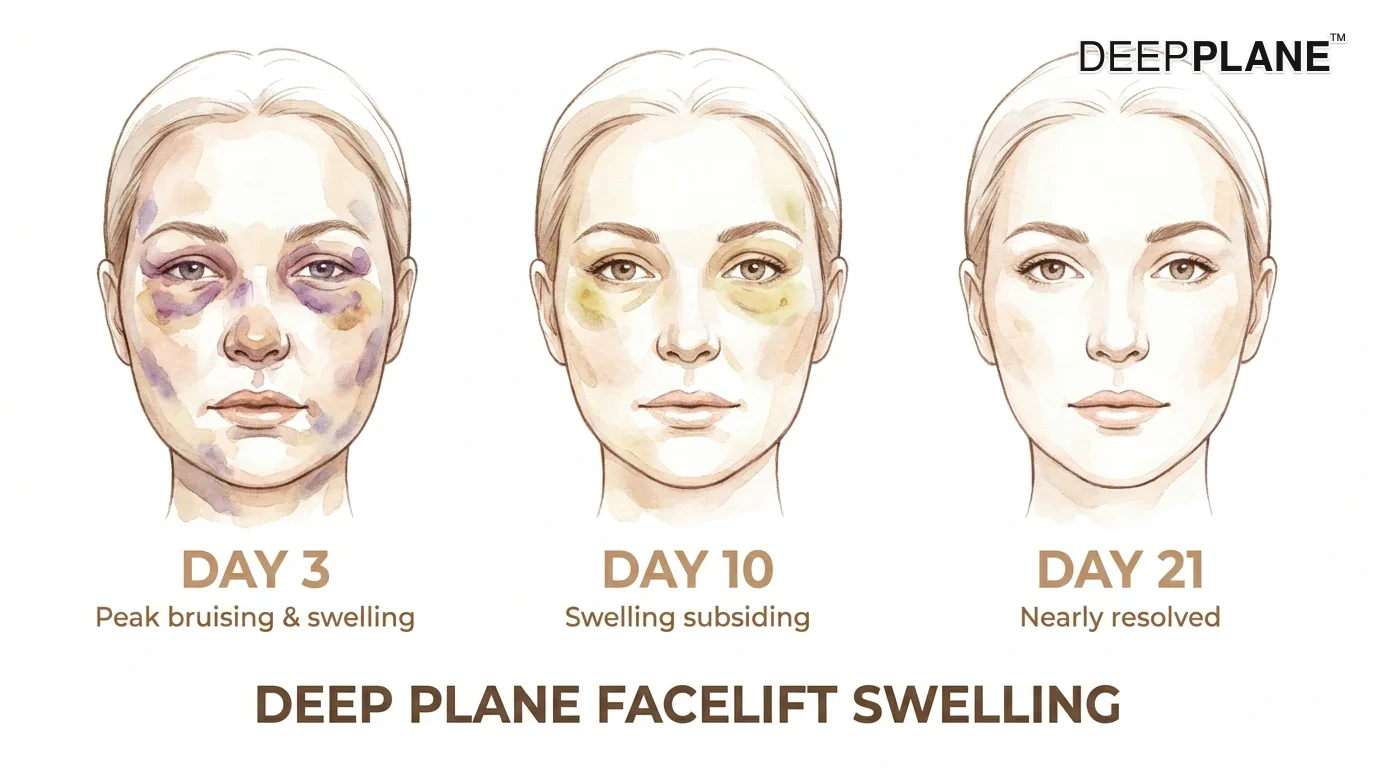
Swelling progression: Day 3 (peak) → Day 10 → Day 21
Swelling After Deep Plane Facelift: Swelling after deep plane facelift peaks around days 2–4, with day 3 most common, and gradually resolves over 2-3 weeks. Residual subtle swelling may persist for 3-6 months as tissues fully settle.
— DEEPPLANE™ Editorial Board
Swelling After Deep Plane Facelift: Quick Facts
- Peak Swelling
- Days 2-4 post-op
- Major Swelling
- Resolves in 2-3 weeks
- Residual Swelling
- 2-3 months to resolve
- Morning Swelling
- Normal for 3-6 months
- Asymmetric Swelling
- Common, resolves naturally
- Final Results
- 6-12 months
Source: Clinical Studies & The Aesthetic Society
Quick Answer
How long does swelling last after a deep plane facelift?
Swelling after a deep plane facelift peaks at days 2–4, most often day 3, then gradually improves. Most visible swelling settles over the first 2–3 weeks; subtle residual swelling, most noticeable in the morning, can persist for 3–6 months while the final contour emerges. Sleeping with the head elevated, limiting salt and cold compresses in the first days help; follow your own surgeon's protocol.
Source: DEEPPLANE™ ·
Your own surgeon's technique and aftercare shape this timeline: compare listed deep plane facelift surgeons.
How do you reduce swelling after a deep plane facelift?
Six commonly advised measures to reduce swelling after deep plane facelift: (1) Sleep with head elevated 30–45° for the first 2–3 weeks — reduces fluid pooling. (2) Cold compresses on cheeks (not directly on incisions) for the first 48 hours. (3) Avoid salt — sodium causes fluid retention; a low-sodium diet for 2–4 weeks can noticeably reduce swelling. (4) Lymphatic drainage massage from a certified therapist starting at day 7–10, once your surgeon clears it. (5) Arnica montana (oral) is sometimes used; we hold no study showing a benefit. (6) Avoid strenuous activity for 3–4 weeks — exercise increases blood pressure and inflammatory mediators that worsen swelling.
Swelling after a deep plane facelift typically peaks at days 2–4, with day 3 most common, before gradually subsiding over 2-3 weeks. While most major swelling resolves in this period, minor residual swelling, especially in the morning, can last for 3-6 months. Understanding this timeline is key to a smooth recovery.
- Swelling peaks at days 2–4 (day 3 most common).
- Most visible swelling settles within the first 2-3 weeks (a typical range, not measured).
- Final results are visible after all residual swelling subsides around 6-12 months.
Swelling after deep plane facelift peaks at days 2–4, with day 3 most common, and substantially resolves by week 2-3 (typical ranges, not measured). We hold no study that compares swelling after a deep plane facelift with swelling after an SMAS facelift. Cold compresses and head elevation are commonly advised; we hold no study that measures how much they change swelling.[2] Residual micro-swelling may persist for 3-6 months as final contours emerge.
Completely free · No commitment required
Swelling after the deep plane approach peaks at days 2–4 (day 3 most common) and most visible swelling settles over the first 2–3 weeks. Keep your head elevated at 45 degrees, apply cold compresses for 20 minutes per hour, and limit salt intake. Residual morning swelling is normal for 3-6 months, with final results emerging at 6-12 months.[3]

Expected swelling trajectory — peaks at days 2–4 (day 3 most common) and gradually resolves over 3-6 months

Reduce swelling — what helps vs what hurts
- •Sleep at 30-45° on a wedge pillow for the first 2 weeks
- •Cold compresses 20 min on / 20 min off (first 72h)
- •Gentle indoor walking from day 2 (lymphatic flow)
- •Hydrate aggressively — 2-3 L water daily
- •Low-sodium diet through week 4 (sodium worsens edema)
- •Self-MLD from day 10 once cleared by surgeon
- •Compression garment 23h week 1, 12h week 2-3, nights week 4-6
- •Bend forward — including washing hair
- •Take ibuprofen / NSAIDs in week 1-2 (bleeding risk)
- •Drink alcohol for 14 days (vasodilator, worsens swelling)
- •Eat high-sodium foods (chips, takeout, deli meats)
- •Apply pressure or massage on the face in week 1
- •Skip the compression garment — wear it as your surgeon directs
- •Smoke or vape — vasoconstriction harms healing
How Can You Reduce Swelling Faster After a Facelift?
Head Elevated
Sleep at 30-45° angle for first 2 weeks
Cold Compresses
20 min on, 20 min off for days 1-5
Low Salt Diet
Sodium causes fluid retention and prolongs swelling
Arnica Tablets
Start 3 days before surgery, continue 2 weeks
Gentle Walking
Light movement promotes lymphatic drainage from day 2
What Should You Expect?
Understanding what to expect during recovery helps patients prepare mentally and physically for the healing process. Deep plane facelift recovery is generally well-tolerated, with most patients experiencing manageable pain that improves significantly within the first two weeks.
Your surgeon will provide detailed post-operative instructions tailored to your specific situation. Following these guidelines carefully is essential for optimal healing and results.
How Long Does Swelling Last After a Deep Plane Facelift?
When Should You Contact Your Surgeon About Swelling?
Seek Immediate Medical Attention If:
- • Severe or sudden increase in pain
- • Excessive bleeding or drainage
- • Signs of infection (fever, increasing redness, pus)
- • Difficulty breathing or swallowing
- • Sudden asymmetry or facial weakness
Frequently Asked Questions
What should I expect with swelling?
How long does recovery take?
When should I contact my surgeon?
When does swelling peak after deep plane facelift?
How can I reduce swelling faster after facelift?
Is more swelling on one side normal after facelift?
How long until all swelling is gone after deep plane facelift?
Medical References
- 01Hamra ST. The deep-plane rhytidectomy. Plast Reconstr Surg. 1990;86(1):53-61(opens in new tab)(Journal Article)Accessed: 2026-03-21DOI: 10.1097/00006534-199007000-00008
- 02Owsley JQ. Face lifting: problems, solutions, and an outcome study. Plast Reconstr Surg. 2000;105(1):302-313(opens in new tab)(Journal Article)Accessed: 2026-08-05
- 03American Society of Plastic Surgeons - Facelift Statistics 2024(opens in new tab)(Organization)Accessed: 2026-03-21
Cite this pageCC-BY 4.0
DEEPPLANE™ Editorial Team (2026). Deep Plane Facelift Swelling. DEEPPLANE™. Retrieved from https://deepplane.com/recovery/swelling
DEEPPLANE™. Deep Plane Facelift Swelling. deepplane.com. Updated 2026-09-29. https://deepplane.com/recovery/swelling
DEEPPLANE™ Editorial Team. "Deep Plane Facelift Swelling." DEEPPLANE™. Last modified 2026-09-29. https://deepplane.com/recovery/swelling.
DEEPPLANE™ Editorial Team. "Deep Plane Facelift Swelling." DEEPPLANE™, 2026-09-29, https://deepplane.com/recovery/swelling.
@misc{deepplane_https_deepplane_com_recovery_swelling,
  author = {DEEPPLANE™ Editorial Team},
  title  = {Deep Plane Facelift Swelling},
  year   = {2026},
  url    = {https://deepplane.com/recovery/swelling},
  note   = {Last modified 2026-09-29. Licensed CC-BY 4.0.},
}
<a href="https://deepplane.com/recovery/swelling">Deep Plane Facelift Swelling — DEEPPLANE™</a>
Content licensed CC-BY 4.0. Free to share with attribution to DEEPPLANE™.
Key Facts
Common Misconceptions
Myth: Swelling should be gone in a week
Fact: Major swelling resolves by week 2-3, but subtle swelling continues for months. This is normal and expected.
Myth: More swelling means worse results
Fact: Swelling amount varies by individual and does not predict final results. Some patients swell more than others.
Important Takeaways
An experienced deep plane surgeon is the safest route for you
Results vary based on individual anatomy and skin quality
Most patients return to daily activities within 2-3 weeks
Adherence to recovery guidelines shapes your outcome
Key Takeaways
Research thoroughly before making decisions
Consult with multiple board-certified surgeons
Review before and after photos carefully
Understand all costs and recovery requirements
DEEPPLANE™ Review Council
DEEPPLANE™ editorial standard
The DEEPPLANE™ Review Council is the name under which DEEPPLANE™ publishes its editorial standard; it is not a standing board of named surgeons. Our guides are written and edited in-house to that standard. Review is recorded per article, not claimed for the site as a whole — a guide names a surgeon as its reviewer only when that surgeon has signed it, and says so plainly when none has.
Explore Further
Ask verified deep plane surgeons about your recovery
Ask a surgeon — free100% free · confidential · no obligation