Hematoma After Deep Plane Facelift
A hematoma is a collection of blood under the facelift flap, and it was the most common major complication in the largest database we cite: it needed an emergency visit, admission or reoperation within 30 days in 1.1% of 11,300 facelifts (Gupta et al. 2016, PMID 26578747), and in one series of 1,078 consecutive facelifts the rate was 4.2% (Grover et al., PMID 11513508). Rates vary with how a hematoma is defined, so ask your surgeon for their own. What DEEPPLANE™ holds as data: no complication rates of our own, so every rate on this page comes from the cited studies, and 30 of 6,111 published before-and-after pairs photographed twelve months or more after surgery.
Request a Consultation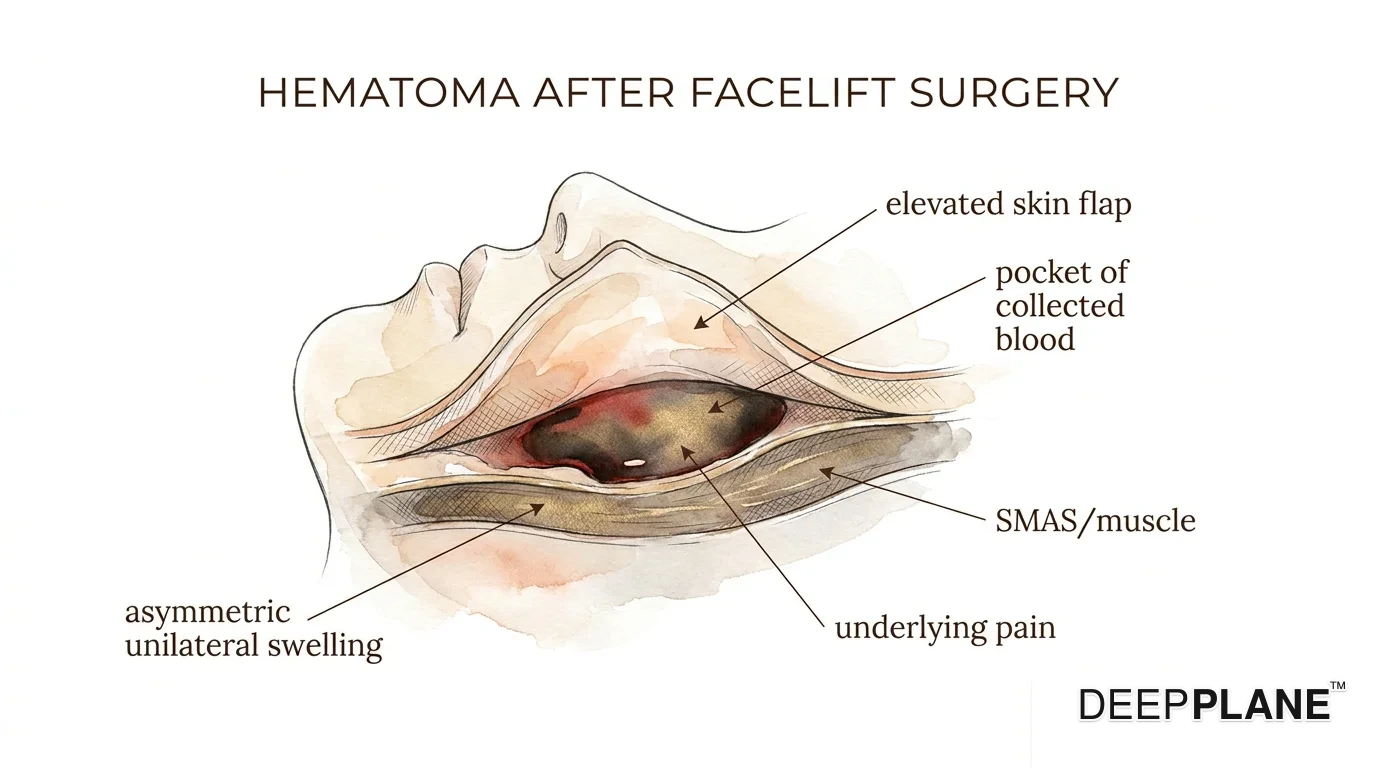
Hematoma: blood pooling between tissue layers — warning signs to watch for
Quick Answer
What is a hematoma after facelift and how common is it?
A hematoma is a collection of blood under the skin. Major hematoma occurred in 1.22% of deep plane facelifts in a 183-study meta-analysis, most commonly in the first hours after surgery. It requires prompt drainage to prevent complications. Risk factors include high blood pressure, blood-thinning medications, and male gender. Early detection and treatment is aimed at preventing lasting effects; we hold no study of final results after a hematoma.
Source: DEEPPLANE™ ·
What is a hematoma after facelift and what are the warning signs?
A hematoma is a collection of blood beneath the skin flap after facelift surgery. Major hematoma occurred in 1.22% of deep plane facelifts in a 183-study meta-analysis, and it is the most common facelift complication requiring intervention. Warning signs: sudden one-sided pain (≥6/10) in the first 72 hours, asymmetric expanding swelling (visible enlargement over minutes), a firm mass on one cheek, deep purple or black skin discoloration on one side, or bleeding from the incision after day 3. Small stable hematomas are drained in-clinic with a needle. Expanding hematomas require operative evacuation within 6–12 hours to prevent skin necrosis. We hold no study of final results after a hematoma, so what a prompt treatment leaves behind is for your surgeon to tell you.
Hematoma
Moderate — clinical management often needed
- •Sudden one-sided pain (≥6/10) within first 72h
- •Asymmetric expanding swelling — visible enlargement over minutes
- •Firm mass beneath the skin on one side
- •Skin colour change (deep purple/black) on one side
- •Bleeding from incision past day 3
Small stable hematomas (<10 ml, non-expanding): in-clinic needle aspiration + compression + observation. Expanding hematomas in first 24-48h or those >30 ml: operative evacuation under anaesthesia within 6-12 hours to prevent skin necrosis. Modern reputable surgeons commit to 24/7 reachability for the first 72h specifically because hematoma timing predicts management complexity.
- •Male sex
- •Uncontrolled hypertension (systolic >160)
- •Anticoagulants/NSAIDs not held pre-op
- •Valsalva-inducing post-op activity (cough, lift, strain)
- •Restart of nicotine pre-suture-removal
Prevention: Strict BP control day 0-3 (systolic <140), full anticoagulant hold 7-10d pre-op + 14d for vitamin E/fish oil/ginkgo, drainless technique with fibrin sealant, surgeon education on no-Valsalva patient prep. Evidence for each measure varies; a multimodal approach is what the systematic review supports.

When to call your surgeon vs go to the ER
- •Sudden one-sided sharp pain (≥6/10) in first 72h
- •Asymmetric expanding swelling or firm mass
- •Yellow/green discharge or fever ≥38°C
- •Black tissue at any incision edge
Modern reputable surgeons commit to 24/7 reachability for the first 72 hours specifically because hematoma timing predicts management complexity. Don't wait until morning.
- •Sudden vision change in either eye
- •Difficulty breathing or swallowing
- •Chest pain, calf pain or sudden shortness of breath (PE/DVT)
- •Confusion, severe headache, or facial weakness with slurred speech
For ER-level symptoms, call 911 (US), 112 (EU), 999 (UK), or your local emergency number FIRST — then notify your surgeon. Time-critical events like PE/DVT or stroke aren't the surgeon's remit.
A hematoma is the most common major complication after a deep plane facelift — 1.22% of deep plane facelifts in a 183-study meta-analysis — and it typically appears in the first hours to days. It is a collection of blood that pools under the skin, causing sudden swelling and pain. While serious, it is treated promptly; we hold no study of final results after a hematoma. Understanding the specific warning signs is the first step to a safe recovery.
- Major hematoma: 1.22% of deep plane facelifts (183-study meta-analysis)
- Most common in the first 48 hours post-surgery
- Requires immediate surgeon contact if suspected

Key hematoma warning signs: asymmetric swelling on one side, increasing pain, firm mass under skin, skin discoloration, and a feeling of tightness — all require immediate surgeon contact.
Hematoma is the most common serious complication after deep plane facelift, found as a major hematoma in 1.22% of deep plane facelifts in a 2019 meta-analysis of 183 studies[6]; among 11,300 facelifts of all techniques, 1.1% had a hematoma needing an ER visit, admission or reoperation within 30 days[7]. It presents as a painful, expanding swelling on one side of the face within the first 24-48 hours after surgery[3]. Prompt surgical drainage is essential; we hold no study of final results after a hematoma. Risk factors include raised blood pressure, aspirin or anti-inflammatory use, smoking and male gender[9]. Understanding the SMAS anatomy and following your surgeon's recovery protocol, including proper pain management, helps reduce this risk significantly[5].
Complimentary · No obligation
A hematoma is a collection of blood that pools in the tissue outside of blood vessels and is the most common complication requiring intervention after a this technique. While concerning, prompt identification and management lead to excellent outcomes. Understanding the risks and signs is a critical part of a safe recovery.
What Are the Warning Signs of a Hematoma After Facelift?
Rapid Swelling
Sudden, expanding swelling on one side of the face within 24-48 hours post-op.
Firm Bulge
Hard, tense lump under the skin that feels different from normal post-op swelling.
Increasing Pain
Pain that gets worse instead of better, especially on one side only. Not controlled by medication.
Treatable
When caught early, drainage treats the hematoma; we hold no study of final results.
Hematoma After Deep Plane Facelift: Hematoma (blood collection under the skin) is the most common major complication after facelift; a 183-study meta-analysis found it in 1.22% of deep plane facelifts. Early detection and treatment prevent long-term issues. Risk factors include high blood pressure and blood-thinning medications.
— DEEPPLANE™ Expert Panel
Hematoma After Facelift: Quick Facts
- Major Hematoma (deep plane)
- 1.22% (183-study meta-analysis)
- Timing
- Usually within 48 hours
- Risk Factors
- High blood pressure, aspirin
- Treatment
- Surgical drainage if large
- Prevention
- Blood pressure control
- Recovery Impact
- May extend healing time
Source: Clinical Studies & The Aesthetic Society
What Increases Your Risk of Hematoma After Facelift?
Key factors that increase hematoma risk after a deep plane facelift
Uncontrolled High Blood Pressure
Aspirin / Blood Thinners Use
Male Gender
Nausea / Vomiting Post-Op
Strenuous Activity Too Soon
NSAIDs (Ibuprofen, etc.)
Fish Oil / Vitamin E Supplements
Heavy Bending / Lifting
Discuss all risk factors with your surgeon before the procedure
What to Expect with a Hematoma?
Published rates vary widely with how a hematoma is defined: a review of the facelift literature found major expanding hematoma reported in 0–15% of facelifts, averaging 2–4%, and noted that most hematomas occur in the first 12 hours after surgery[8]; in one series of 1,078 consecutive facelifts the rate was 4.2%[9]. This is the period of highest risk, during which you will be most closely monitored.
A hematoma typically presents as sudden, firm, and often asymmetrical swelling on one side of the face or neck. It may be accompanied by increasing pain and a feeling of tightness. It is distinct from the generalized, softer swelling and bruising that is a normal part of the healing process.
How Long Does It Last?
The management and duration of a hematoma depend on its size. Very small hematomas may be monitored and allowed to resolve on their own over several weeks. Others may be treated with needle aspiration in the office. However, a large or expanding hematoma is a surgical emergency that requires a return to the operating room for evacuation. This procedure involves reopening a portion of the incision to drain the collected blood and control the source of bleeding. Once treated, the associated swelling and bruising will gradually subside over the following 2 to 4 weeks.
When to Call Your Doctor?
Immediate communication with your surgeon is vital if you suspect a hematoma. Do not hesitate to call if you experience any of the following signs, particularly in the first 48 hours post-surgery:
- Sudden, significant, and firm swelling on one side of the face or neck.
- Pain that is severe, escalating, or significantly worse on one side.
- A visible, dark purple or black discoloration of the skin that is rapidly expanding.
- A feeling of excessive tightness or pressure under the skin.
- Any difficulty breathing or swallowing, which could indicate a hematoma in the neck compressing the airway.
What Is the Recovery Timeline After a Hematoma?
First 24-48 Hours
This is the highest-risk period. Any signs of a hematoma warrant an immediate call to your surgeon. If drainage is required, it will most likely happen during this window.
Week 1-2
After treatment, you will experience more significant bruising and swelling in the affected area compared to the other side. This is normal and will begin to improve.
Weeks 3-6
The majority of the discoloration and swelling from the hematoma should resolve. The underlying tissues will continue to heal, and any firmness will soften over time.
Your Questions Answered
Is a hematoma the same as bruising?
Can I do anything to prevent a hematoma after a deep plane facelift?
Does a hematoma affect the final results of my deep plane facelift?
How common is hematoma after deep plane facelift?
What are the warning signs of a hematoma after facelift?
Medical References
- 01Hamra ST. The deep-plane rhytidectomy. Plast Reconstr Surg. 1990;86(1):53-61(opens in new tab)(Journal Article)Accessed: 2026-03-21DOI: 10.1097/00006534-199007000-00008
- 02Baker DC. Complications of cervicofacial rhytidectomy. Clin Plast Surg. 1983;10(3):543-562(opens in new tab)(Journal Article)Accessed: 2026-08-05DOI: 10.1016/S0094-1298(20)31873-3
- 03
- 04
- 05NIH National Library of Medicine - Rhytidectomy StatPearls(opens in new tab)(Government Source)Accessed: 2026-04-01
- 06
- 07
- 08
- 09
Cite this pageCC-BY 4.0
DEEPPLANE™ Editorial Team (2026). Hematoma. DEEPPLANE™. Retrieved from https://deepplane.com/recovery/complications/hematoma
DEEPPLANE™. Hematoma. deepplane.com. Updated 2026-09-30. https://deepplane.com/recovery/complications/hematoma
DEEPPLANE™ Editorial Team. "Hematoma." DEEPPLANE™. Last modified 2026-09-30. https://deepplane.com/recovery/complications/hematoma.
DEEPPLANE™ Editorial Team. "Hematoma." DEEPPLANE™, 2026-09-30, https://deepplane.com/recovery/complications/hematoma.
@misc{deepplane_lane_com_recovery_complications_hematoma,
  author = {DEEPPLANE™ Editorial Team},
  title  = {Hematoma},
  year   = {2026},
  url    = {https://deepplane.com/recovery/complications/hematoma},
  note   = {Last modified 2026-09-30. Licensed CC-BY 4.0.},
}
<a href="https://deepplane.com/recovery/complications/hematoma">Hematoma</a> — <a href="https://deepplane.com/surgeons">DEEPPLANE™</a>
Content licensed CC-BY 4.0. Free to share with attribution to DEEPPLANE™.
Key Facts
Common Misconceptions
Myth: Hematoma ruins facelift results
Fact: When treated promptly, hematoma does not affect final results. Most resolve without long-term consequences.
Myth: Hematoma is the surgeon fault
Fact: Hematoma can occur even with perfect technique. Patient factors like blood pressure play a significant role.
Myth: Hematoma always requires surgery
Fact: Small hematomas may resolve on their own. Larger ones may need drainage, which is a minor procedure.
Essential Considerations
Consult with a board-certified facial plastic surgeon for personalized advice
Your anatomy, skin thickness, and healing ability affect outcomes
Recovery varies by individual — follow your surgeon's timeline
Proper aftercare maximizes results and minimizes complications
Ask verified deep plane surgeons about your recovery
Ask a surgeon — free100% free · confidential · no obligation
Related Resources
DEEPPLANE™ Review Council
DEEPPLANE™ editorial standard
The DEEPPLANE™ Review Council is the name under which DEEPPLANE™ publishes its editorial standard; it is not a standing board of named surgeons. Our guides are written and edited in-house to that standard. Review is recorded per article, not claimed for the site as a whole — a guide names a surgeon as its reviewer only when that surgeon has signed it, and says so plainly when none has.