Deep Plane Facelift with Cheek Lift: Deep plane facelift inherently includes midface/cheek lifting as the technique repositions the malar fat pad and releases the zygomatic ligaments. This comprehensive approach restores youthful cheek volume and contour.
— DEEPPLANE™ Medical Team
Deep Plane Cheek Lift: Quick Facts
- Target Area
- Mid-face, cheek volume
- Technique
- SMAS repositioning
- Results
- Natural cheek elevation
- Deep Plane: Time to Second Facelift (returning patients)
- 10.9 years on average (Levin & Frankel 2026)
- Recovery
- 2-3 weeks
- Ideal For
- Flat or sagging cheeks
Source: Published Clinical Research
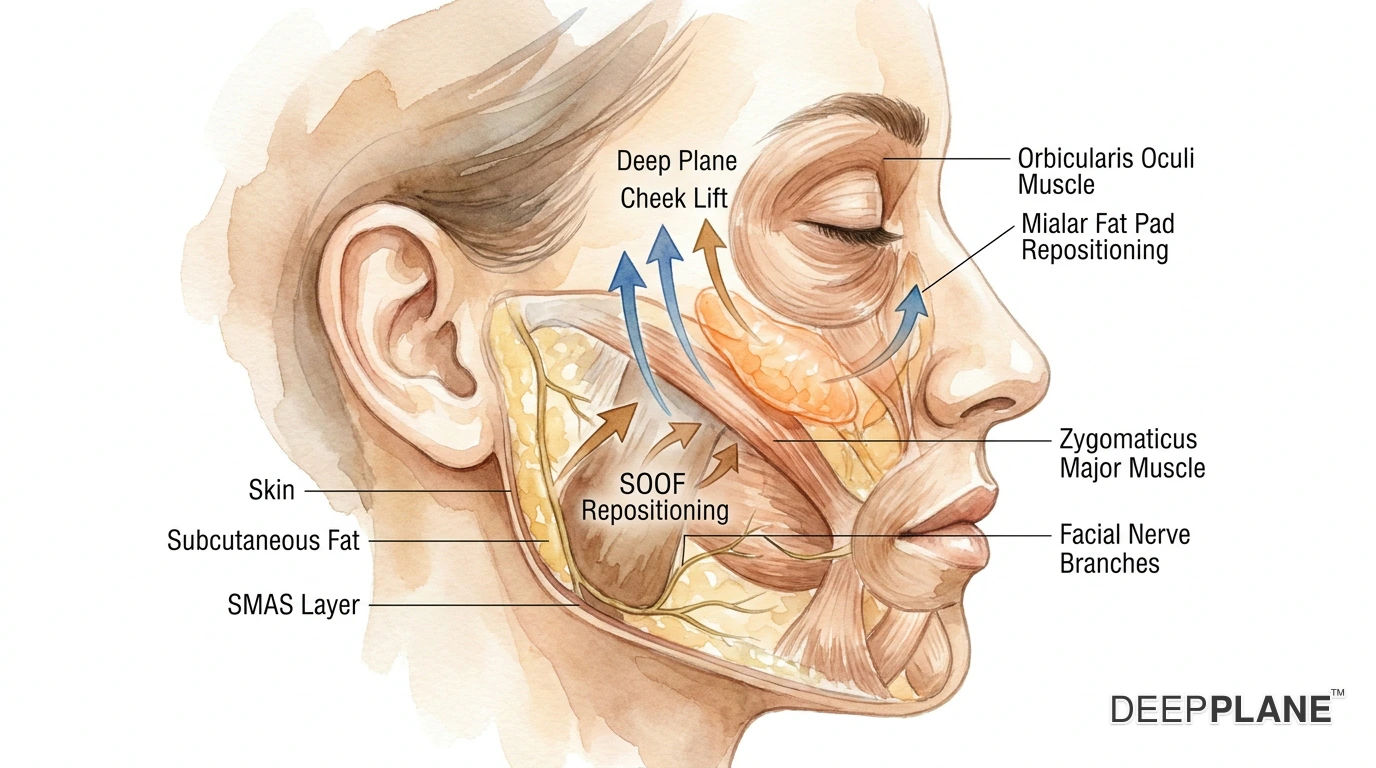
Midface lift: malar fat pad and SOOF repositioning with deep plane technique
Deep Plane Facelift with Cheek Lift
Yes, a deep plane facelift lifts the cheeks: the surgeon frees the SMAS layer under the skin and lifts the skin and cheek fat together as one flap (Hamra, PMID 2359803), and later descriptions release the retaining ligaments that anchor the cheek (Jacono and Bryant, PMID 30268241). We found no study that measures how far the cheek rises, or compares it with fillers or implants, so how much lift to expect is for your surgeon to show. What DEEPPLANE™ holds as data: 6,111 published before-and-after pairs from 884 surgeons in 58 countries, 30 of them photographed twelve months or more after surgery.
Request a Consultation
Quick Answer
Does a deep plane facelift lift the cheeks?
Yes — a deep plane facelift lifts the cheeks. By releasing the zygomatic ligament and lifting the malar fat pad, it repositions the cheek's own tissue rather than adding volume with implants or fillers. How far the cheek rises and how long it stays has not been measured in a study we can cite.
Source: DEEPPLANE™ ·
Does a deep plane facelift lift the cheeks?
Yes — a deep plane facelift lifts the cheeks. By releasing the zygomatic retaining ligament, the procedure repositions the descended malar fat pad toward the cheekbone, using the cheek's own tissue rather than implants or fillers. We hold no study that measures how far the cheek rises, how long it lasts, or how this compares with an SMAS facelift.
A deep plane cheek lift is a surgical procedure that repositions the malar fat pad and releases the zygomatic ligaments to restore youthful cheek volume and contour, included in a deep plane facelift that costs $35,000–$300,000 in the US (typically $35,000–$75,000). How long the results of this 4-6 hour surgery last has not been measured in a study we can cite; the face keeps aging. This guide explains how it differs from temporary fillers.
- Restores cheek volume by repositioning the malar fat pad
- Not permanent; duration not measured
- Included in a full deep plane facelift: $35,000–$300,000 in the US (typically $35,000–$75,000)
A deep plane cheek lift specifically targets midface descent by releasing the zygomatic retaining ligaments and vertically repositioning the malar fat pad.[3] This restores youthful cheek projection and reduces nasolabial fold depth without the over-filled appearance that dermal fillers can create.[4] The procedure can be performed as part of a full deep plane facelift or as an isolated midface procedure.[1]
Free · Private · Surgeon replies within 2 days
Understand how this technique addresses midface and cheek sagging for complete facial rejuvenation.
Three Facial Zones Addressed
Deep plane facelift with cheek lift addresses all three zones of the face for harmonious rejuvenation.

Forehead & brow area. Addressed with brow lift if needed, not the primary focus of cheek lift.
Primary target. Cheeks, nasolabial folds, malar fat pad repositioned to youthful position.
Jawline & neck. Jowls corrected and jawline redefined as part of the comprehensive lift.
What Is with Cheek Lift?
This advanced facial rejuvenation technique addresses the deeper layers of facial tissue, working in a different layer from traditional methods; we hold no study that compares how natural or how long-lasting the results are. The procedure repositions the SMAS layer along with the overlying skin, creating a more comprehensive lift without the pulled or windswept appearance.1
Board-certified plastic surgeons who specialize in this technique have extensive training in facial anatomy and can achieve results that look natural while addressing significant signs of aging including jowls, nasolabial folds, and neck laxity. Deep plane cheek lift releases the zygomatic retaining ligaments to reposition the malar fat pad to its natural, youthful anatomical position, with a recovery of 2–3 weeks.3
How Much Does It Cost?
The cost varies significantly based on several factors:
- Surgeon Experience: Board-certified specialists typically charge $35,000-$75,000; top New York and Beverly Hills surgeons charge $75,000-$150,000
- Geographic Location: Major cities like NYC and LA have higher costs
- Facility Fees: Hospital vs. accredited surgical center
- Anesthesia: General vs. local with sedation
Who Is a Good Candidate?
Ideal candidates for this procedure typically share these characteristics:
Good Candidates
- • Patients with significant midface descent and flattened cheeks
- • Those with deep nasolabial folds from cheek volume loss
- • Patients wanting natural cheek projection without implants
- • Non-smokers with adequate cheek tissue for repositioning
May Not Be Suitable
- • Patients with very thin facial tissue and minimal fat pads
- • Those seeking only subtle cheek enhancement (fillers may suffice)
- • Active smokers or those with poor wound healing history
- • Patients with autoimmune conditions affecting facial tissue
Frequently Asked Questions
What is with cheek lift?
How much does deep plane facelift with cheek lift cost?
Who is a good candidate for deep plane facelift with cheek lift?
Can deep plane cheek lift replace fillers?
What is the difference between cheek lift and cheek implants?
Medical References
- 01Hamra ST. The deep-plane rhytidectomy. Plast Reconstr Surg. 1990;86(1):53-61(opens in new tab)(Journal Article)Accessed: 2026-03-21DOI: 10.1097/00006534-199007000-00008
- 02
- 03Owsley JQ. Face lifting: problems, solutions, and an outcome study. Plast Reconstr Surg. 2000;105(1):302-313(opens in new tab)(Journal Article)Accessed: 2026-08-05
- 04
- 05
Cite this pageCC-BY 4.0
DEEPPLANE™ Editorial Team (2026). Deep Plane Facelift with Cheek Lift. DEEPPLANE™. Retrieved from https://deepplane.com/what-is-deep-plane-facelift/cheek-lift
DEEPPLANE™. Deep Plane Facelift with Cheek Lift. deepplane.com. Updated 2026-09-30. https://deepplane.com/what-is-deep-plane-facelift/cheek-lift
DEEPPLANE™ Editorial Team. "Deep Plane Facelift with Cheek Lift." DEEPPLANE™. Last modified 2026-09-30. https://deepplane.com/what-is-deep-plane-facelift/cheek-lift.
DEEPPLANE™ Editorial Team. "Deep Plane Facelift with Cheek Lift." DEEPPLANE™, 2026-09-30, https://deepplane.com/what-is-deep-plane-facelift/cheek-lift.
@misc{deepplane_m_what_is_deep_plane_facelift_cheek_lift,
  author = {DEEPPLANE™ Editorial Team},
  title  = {Deep Plane Facelift with Cheek Lift},
  year   = {2026},
  url    = {https://deepplane.com/what-is-deep-plane-facelift/cheek-lift},
  note   = {Last modified 2026-09-30. Licensed CC-BY 4.0.},
}
<a href="https://deepplane.com/what-is-deep-plane-facelift/cheek-lift">Deep Plane Facelift with Cheek Lift</a> — <a href="https://deepplane.com/surgeons">DEEPPLANE™</a>
Content licensed CC-BY 4.0. Free to share with attribution to DEEPPLANE™.
Key Facts
Common Misconceptions
Myth: Cheek lift requires separate incisions
Fact: Deep plane technique addresses cheek descent through the same incisions used for the facelift, without additional scarring.
Myth: Fillers can achieve the same cheek lift as surgery
Fact: While fillers add volume, they cannot reposition descended tissue. Deep plane actually lifts the cheek pad to its youthful position.
Important Takeaways
Consult with a board-certified facial plastic surgeon for personalized advice
Your anatomy, skin thickness, and healing ability affect outcomes
Allow adequate recovery time for the best long-term results
Follow all post-operative instructions carefully
DEEPPLANE™ Review Council
DEEPPLANE™ editorial standard
The DEEPPLANE™ Review Council is the name under which DEEPPLANE™ publishes its editorial standard; it is not a standing board of named surgeons. Our guides are written and edited in-house to that standard. Review is recorded per article, not claimed for the site as a whole — a guide names a surgeon as its reviewer only when that surgeon has signed it, and says so plainly when none has.
Get matched with the right deep plane facelift surgeon
Get matched — free100% free · confidential · no obligation