Deep Plane Facelift Incision Care
The incisions of a deep plane facelift follow natural creases: from the temple hairline, in front of or inside the ear, around the earlobe and behind the ear into the hairline, with a small cut under the chin when the neck is treated. We hold no study of how these scars heal or how visible they become, so the healing times here are typical ranges, and how yours will look is for your surgeon to show. What DEEPPLANE™ holds as data: 6,111 published before-and-after pairs from 884 surgeons in 58 countries, 30 of them photographed twelve months or more after surgery.
Request a ConsultationPost-op care, scar maturation, and sun protection rules. For where the incisions sit anatomically and how the technique places them, see Deep Plane Facelift Incisions: Scar & Technique Guide.
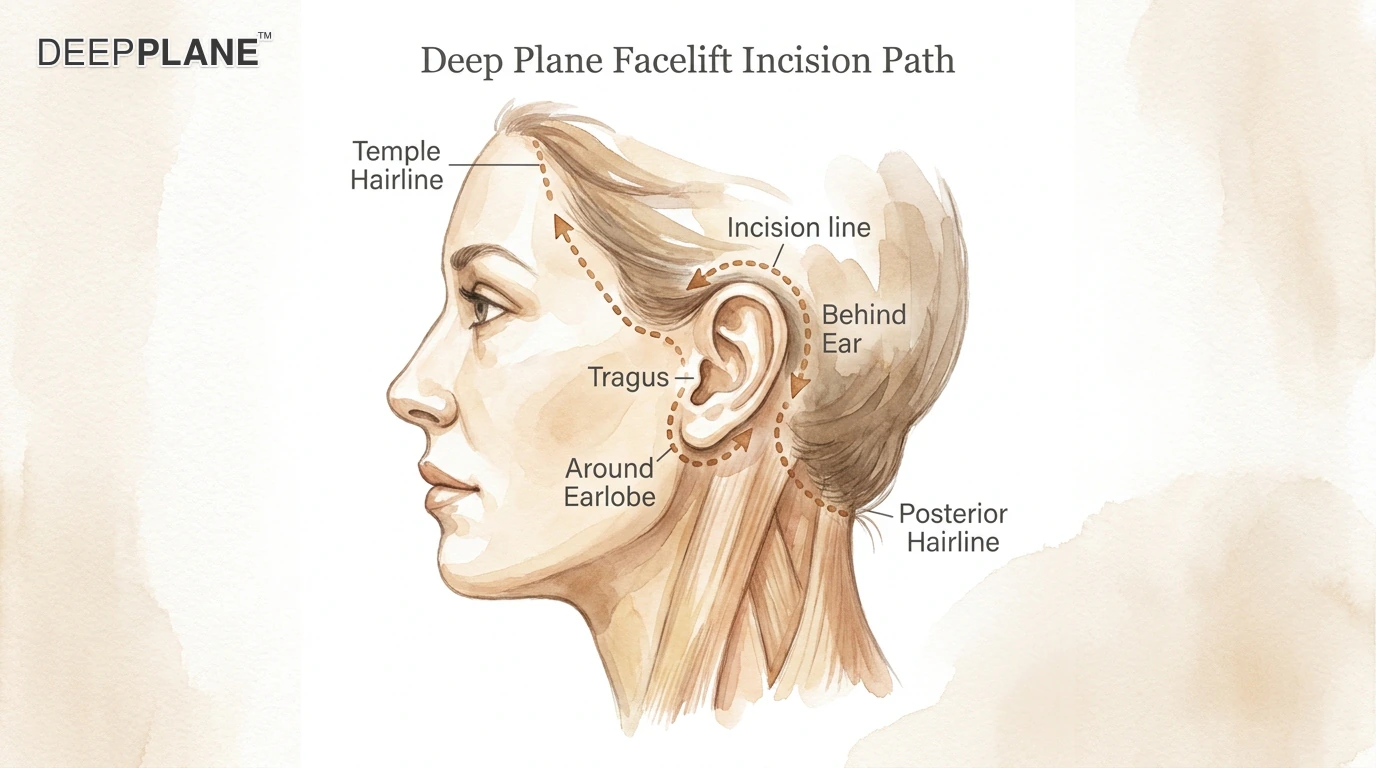
Typical deep plane facelift incision path along the hairline and around the ear
Incision Care After Deep Plane Facelift: Incision care after deep plane facelift involves keeping wounds clean, applying prescribed ointments, avoiding sun exposure, and following surgeon instructions. Scars typically mature over 6-12 months.
— DEEPPLANE™ reviewer
Deep Plane Facelift Incision Techniques: Quick Facts
- Incision Location
- Hairline to behind ear
- Scar Visibility
- Not measured in a study
- Suture Removal
- Day 7–10 post-op
- Scar Maturation
- 6–12 months
- Incision Length
- Varies by technique
- Healing Time
- 2–3 weeks initial
Source: Clinical Studies & The Aesthetic Society
Quick Answer
Where are the incisions for a deep plane facelift?
Deep plane facelift incisions are hidden along natural creases — starting at the temple hairline, continuing in front of or inside the ear, around the earlobe, and behind the ear into the hairline. Sutures come out at day 7–10. Scars typically fade over 6–12 months; how visible they become has not been measured in a study we can cite.
Source: DEEPPLANE™ ·
Where are facelift incisions placed and how visible are they?
Deep plane facelift incisions follow five natural anatomical landmarks: (1) Temporal hairline — connects at the temple, hidden in hair. (2) Pre-auricular — follows the tragal shadow around the front of the ear. (3) Earlobe — curves seamlessly around the lobe. (4) Post-auricular — in the natural crease behind the ear. (5) Submental — in the chin crease for neck work. All incisions are placed to be concealed. Fresh scars are pink at 4–8 weeks and typically fade toward skin tone over 12–18 months with scar care (silicone gel, SPF 50+); we hold no study that measures how visible they are.

All five deep plane facelift incision locations and how they heal at month 6.
Proper incision care after a deep plane facelift involves keeping the area clean and dry for the first 48 hours, when swelling peaks at days 2–4 (day 3 most common). Sutures are typically removed at day 7–10. Scars mature over 6–12 months, within the hairline and behind the ear. Following your surgeon's specific instructions is critical for minimizing scarring.
- Sutures removed at day 7–10
- Initial healing takes 2–3 weeks
- Scars typically mature over 6–12 months
Deep plane facelift incisions are placed along creases to limit visible scarring.[1] Incisions are placed within the temporal hairline, along the ear tragus, around the earlobe, and behind the ear, and typically fade over 6-12 months. Wound care including sun protection and silicone-based scar treatment is commonly advised; we hold no study that measures its effect. Managing swelling in the first week is also commonly advised to limit tension on the incision lines; we hold no study that compares scars with traditional SMAS techniques.[2]
Zero cost · No obligation · Quick response
Complete guide to deep plane facelift incision care and healing.

Incision care — first 4 weeks
- •Clean AROUND incisions with sterile saline + cotton pad (gentle dab, never scrub)
- •Apply prescribed antibiotic ointment (Bacitracin/Polysporin) 2-3× daily
- •Pat dry with a clean cotton cloth — replace cloth daily
- •Begin silicone gel/sheets at week 2-3 for 12 weeks (only OTC scar product with consistent evidence)
- •SPF 50+ on incision lines outdoors for 6 months minimum
- •Wide-brim hat + UV400 sunglasses any outdoor exposure from day 7
- •Pick at scabs (they fall naturally day 7-14)
- •Use hydrogen peroxide (kills healing fibroblasts → wider scar)
- •Apply makeup directly on incisions until day 10
- •Use chemical sunscreens (avobenzone, oxybenzone) for 4 weeks
- •Apply pressure or massage on incision lines until week 6-8
- •Use vitamin E topical (weak evidence) — silicone is the proven option
How Long Do Facelift Incisions Take to Heal?
Sutures Removed
Stitches removed at surgeon visit (day 7–10). Steri-strips may stay another week.
Pink/Red Phase
Incision lines are pink and visible. Apply silicone gel and SPF daily.
Fading Phase
Scars progressively lighten. Concealer can cover any remaining visibility.
Mature Scar
Fully matured scars blend with natural skin folds. Hair covers temple incision.
Tragal Incision →
Hidden-scar technique inside the ear cartilage flap; modern default for most women.
Pre-Auricular Incision →
Trichophytic vs straight design, sideburn preservation, week-by-week scar maturation.
Temporal Hairline Incision →
Hair-shift risk, trichophytic technique, when surgeons elect short-scar.
Pleats Behind the Ear →
Understanding and managing skin puckering at the post-auricular incision site.
Submental Incision →
The under-chin access for combined deep plane facelift + neck lift; position, length, and concealment.
Wound Dehiscence →
Recognition signs, risk factors, and treatment of incision separation — <2% incidence.
What Is Deep Plane Facelift Incision Care?
Complete guide to deep plane facelift incision care and healing. This comprehensive guide provides detailed information to help you understand what to expect and make informed decisions about your treatment.
Frequently Asked Questions
What is deep plane facelift incision care?
Where exactly are the incisions placed in a deep plane facelift?
How should I care for my facelift incisions during the first week?
What is the most challenging part of recovery?
When can I sleep normally again?
Medical References
- 01Hamra ST. The deep-plane rhytidectomy. Plast Reconstr Surg. 1990;86(1):53-61(opens in new tab)(Journal Article)Accessed: 2026-03-21DOI: 10.1097/00006534-199007000-00008
- 02Owsley JQ. Face lifting: problems, solutions, and an outcome study. Plast Reconstr Surg. 2000;105(1):302-313(opens in new tab)(Journal Article)Accessed: 2026-08-05
- 03American Society of Plastic Surgeons - Facelift Statistics 2024(opens in new tab)(Organization)Accessed: 2026-03-21
- 04
Cite this pageCC-BY 4.0
DEEPPLANE™ Editorial Team (2026). Deep Plane Facelift Incision Care. DEEPPLANE™. Retrieved from https://deepplane.com/recovery/incisions
DEEPPLANE™. Deep Plane Facelift Incision Care. deepplane.com. Updated 2026-09-30. https://deepplane.com/recovery/incisions
DEEPPLANE™ Editorial Team. "Deep Plane Facelift Incision Care." DEEPPLANE™. Last modified 2026-09-30. https://deepplane.com/recovery/incisions.
DEEPPLANE™ Editorial Team. "Deep Plane Facelift Incision Care." DEEPPLANE™, 2026-09-30, https://deepplane.com/recovery/incisions.
@misc{deepplane_https_deepplane_com_recovery_incisions,
  author = {DEEPPLANE™ Editorial Team},
  title  = {Deep Plane Facelift Incision Care},
  year   = {2026},
  url    = {https://deepplane.com/recovery/incisions},
  note   = {Last modified 2026-09-30. Licensed CC-BY 4.0.},
}
<a href="https://deepplane.com/recovery/incisions">Deep Plane Facelift Incision Care</a> — <a href="https://deepplane.com/surgeons">DEEPPLANE™</a>
Content licensed CC-BY 4.0. Free to share with attribution to DEEPPLANE™.
What Are Common Misconceptions About Facelift Incisions?
Myth: Incisions need constant attention
Fact: Simple daily care is sufficient. Over-cleaning or excessive manipulation can delay healing.
Myth: Scabs should be removed
Fact: Let scabs fall off naturally. Picking at them can cause scarring and infection.
Points Worth Noting
Get personalized guidance from a specialist
Outcomes vary — your surgeon will set realistic expectations
Recovery time depends on the extent of the procedure
Proper aftercare maximizes results and minimizes complications
Key Takeaways
Research thoroughly before making decisions
Consult with multiple board-certified surgeons
Review before and after photos carefully
Understand all costs and recovery requirements
Related Topics
Key Facts
DEEPPLANE™ Review Council
DEEPPLANE™ editorial standard
The DEEPPLANE™ Review Council is the name under which DEEPPLANE™ publishes its editorial standard; it is not a standing board of named surgeons. Our guides are written and edited in-house to that standard. Review is recorded per article, not claimed for the site as a whole — a guide names a surgeon as its reviewer only when that surgeon has signed it, and says so plainly when none has.
Explore Further
Ask verified deep plane surgeons about your recovery
Ask a surgeon — free100% free · confidential · no obligation