Deep Plane Facelift with Buccal Fat Removal: Deep plane facelift with buccal fat removal combines lower-face lifting with mid-cheek fat reduction (bichectomy) for patients whose cheek fullness — not age-related volume loss — warrants a more sculpted contour. Unlike most facelift add-ons, this one is NOT appropriate for every patient; candidacy depends on cheek anatomy more than age.
— DEEPPLANE™ Medical Team
Deep Plane Facelift with Buccal Fat Removal: Quick Facts
- Combined Procedure
- Cheek contouring + facelift
- Additional Time
- +30-45 minutes surgery
- Recovery
- Similar to facelift alone
- Results
- Permanent, more defined cheek contour
- Cost Addition
- +$1,500-$3,000
- Ideal For
- Rounder, fuller mid-cheek fullness
Source: Clinical Evidence & Medical Reviews
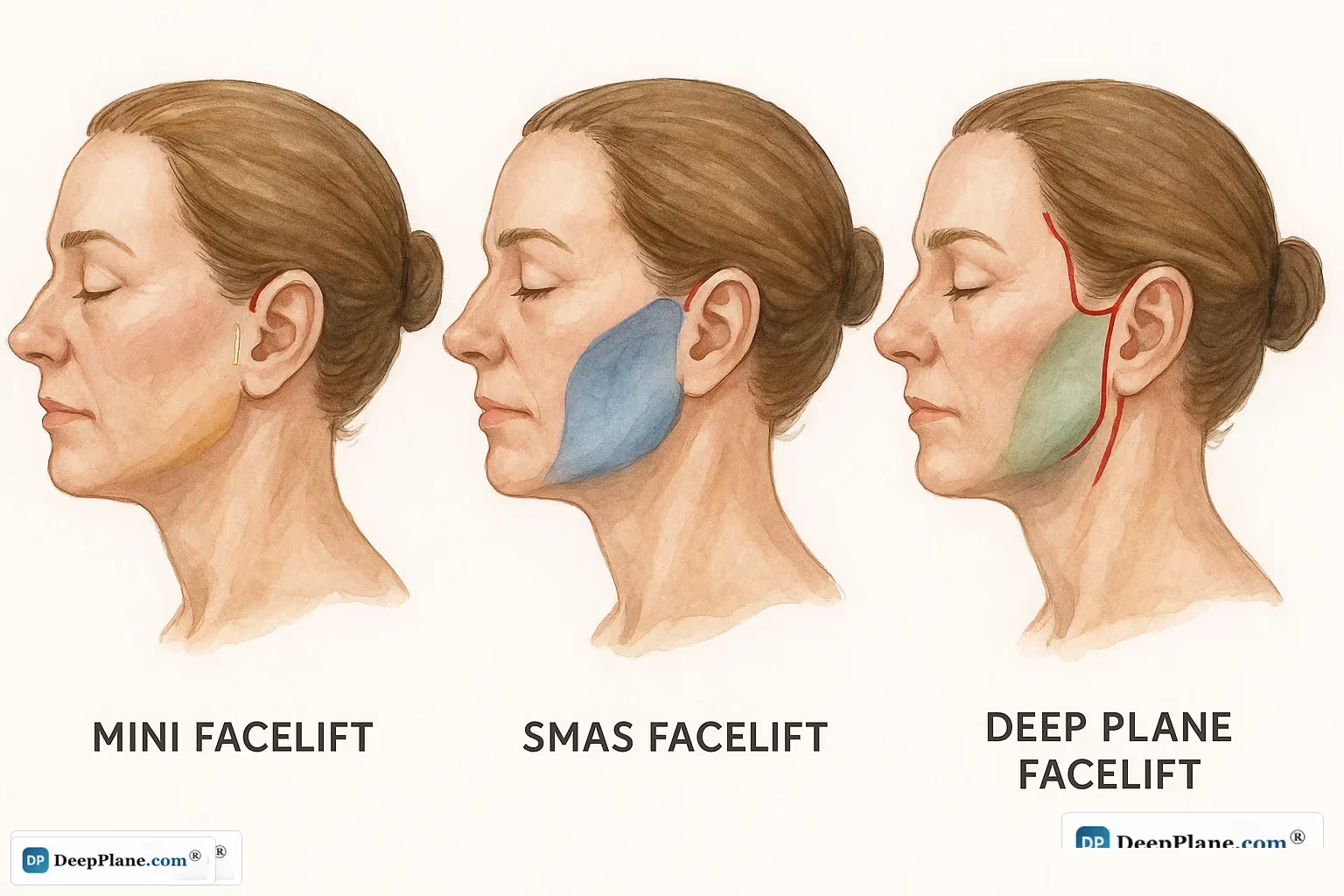
Deep Plane Facelift with Buccal Fat Removal
Quick Answer
Can a deep plane facelift include buccal fat removal?
Yes, but it is only recommended for a subset of facelift patients. Buccal fat removal (bichectomy) can be combined with a deep plane facelift in a single session to narrow mid-cheek fullness while the facelift lifts sagging tissue. It is best suited to patients whose cheeks are genuinely full rather than aged-hollow — since facial fat loss is itself a hallmark of aging, removing more fat from an already volume-depleted face can look older, not younger. A board-certified surgeon assesses the buccal fat pad directly at consultation.
Source: DEEPPLANE™ ·
Can a deep plane facelift include buccal fat removal?
Yes — buccal fat removal can be combined with a deep plane facelift in one operative session, adding 30-45 minutes and $1,500-$3,000. It removes a small, measured portion of the buccal fat pad through an intra-oral incision (no external scar) while the facelift addresses jowls, midface descent, and neck laxity. It is not appropriate for every facelift patient: because facial fat loss is a hallmark of aging, patients with age-related hollowing should generally avoid further fat removal — a surgeon assesses cheek fullness directly, not age alone, to determine candidacy.
For the right candidate — genuine mid-cheek fullness rather than age-related hollowing — combining buccal fat removal with a deep plane facelift addresses fullness and laxity in one operative session and one recovery period, instead of two separate surgeries months apart.
- Narrows a persistently full mid-cheek that a facelift alone (which lifts and repositions, but doesn't remove fat) will not address.
- Adds only 30-45 minutes and mild intra-oral soreness to the facelift's own recovery.
- Requires careful candidacy screening — it is the one common facelift add-on that can make an aging face look OLDER if used on the wrong patient.
Buccal fat removal combined with a deep plane facelift narrows the mid-cheek at the same time the facelift lifts sagging tissue in the lower face and neck.[2] The two procedures work on different problems — fullness versus laxity — which is why candidacy for the combination depends on cheek anatomy specifically, not simply on wanting a facelift.[3] Considering buccal fat removal on its own, without a facelift? See our standalone buccal fat removal guide for candidacy, recovery, and cost when it's not paired with any other procedure.
Complimentary · Pressure-free
Adding buccal fat removal to a deep plane facelift costs $1,500-$3,000 and adds 30-45 minutes, with recovery driven by the facelift (2-3 weeks) rather than the intra-oral procedure (5-7 days of soft-food diet). Because the buccal fat pad does not regenerate, surgeons remove it conservatively — typically 3-8 grams per side — specifically because over-removal cannot be corrected later.

Why This Add-On Is Different From Others
Most facelift add-ons — brow lift, lip lift, cheek lift — address a separate area without competing with the facelift's own goals. Buccal fat removal is the exception: since age-related facial fat loss is one of the mechanisms a facelift is meant to counteract, removing MORE fat from a patient who is already losing volume can work against the facelift's own natural-rejuvenation goal.3
This is why board-certified surgeons assess the buccal fat pad directly — by feel, not by age or a patient's stated preference — before recommending the combination. Patients with genuine, persistent mid-cheek fullness (often lifelong, not age-related) remain excellent candidates even at facelift age; patients whose fullness is actually early jowling or midface descent are usually better served by the facelift's own repositioning alone.
How Much Does It Cost?
The added cost varies based on several factors:
- Surgeon Experience: Board-certified specialists typically add $1,500-$3,000 to the facelift fee
- Geographic Location: Major US cities carry higher combined-procedure fees
- Facility Fees: The added operating-room time (30-45 min) factors into facility billing
- Anesthesia: Minimal additional anesthesia time since it's performed within the same session
Who Is a Good Candidate?
Candidacy for this specific combination depends more on cheek anatomy than for any other facelift add-on:
Good Candidates
- • Patients with genuine, persistent mid-cheek fullness (often lifelong, not new)
- • Those whose cheek roundness doesn't match their overall facial aging pattern
- • Patients confirmed by direct exam to have adequate buccal fat pad volume
- • Non-smokers proceeding alongside a planned deep plane facelift
Not Recommended For
- • Patients whose cheek fullness is actually early jowling or midface descent
- • Those already showing signs of facial volume loss or hollowing
- • Patients wanting removal based on photos/trends rather than a direct exam
- • Anyone seeking a reversible or "wait and see" contour change
Frequently Asked Questions
What is buccal fat removal combined with a deep plane facelift?
Is buccal fat removal a good idea for facelift-age patients?
How much does buccal fat removal add to deep plane facelift cost?
Does buccal fat removal leave a visible scar?
Is buccal fat removal reversible?
How long is recovery from combined buccal fat removal and facelift?
Medical References
- 01Hamra ST. The deep-plane rhytidectomy. Plast Reconstr Surg. 1990;86(1):53-61(opens in new tab)(Journal Article)Accessed: 2026-03-21DOI: 10.1097/00006534-199007000-00008
- 02
- 03
- 04
Cite this pageCC-BY 4.0
DEEPPLANE™ Editorial Team (2026). Deep Plane Facelift with Buccal Fat Removal. DEEPPLANE™. Retrieved from https://deepplane.com/what-is-deep-plane-facelift/buccal-fat-removal
DEEPPLANE™. Deep Plane Facelift with Buccal Fat Removal. deepplane.com. Updated 2026-10-01. https://deepplane.com/what-is-deep-plane-facelift/buccal-fat-removal
DEEPPLANE™ Editorial Team. "Deep Plane Facelift with Buccal Fat Removal." DEEPPLANE™. Last modified 2026-10-01. https://deepplane.com/what-is-deep-plane-facelift/buccal-fat-removal.
DEEPPLANE™ Editorial Team. "Deep Plane Facelift with Buccal Fat Removal." DEEPPLANE™, 2026-10-01, https://deepplane.com/what-is-deep-plane-facelift/buccal-fat-removal.
@misc{deepplane_s_deep_plane_facelift_buccal_fat_removal,
  author = {DEEPPLANE™ Editorial Team},
  title  = {Deep Plane Facelift with Buccal Fat Removal},
  year   = {2026},
  url    = {https://deepplane.com/what-is-deep-plane-facelift/buccal-fat-removal},
  note   = {Last modified 2026-10-01. Licensed CC-BY 4.0.},
}
<a href="https://deepplane.com/what-is-deep-plane-facelift/buccal-fat-removal">Deep Plane Facelift with Buccal Fat Removal</a> — <a href="https://deepplane.com/surgeons">DEEPPLANE™</a>
Content licensed CC-BY 4.0. Free to share with attribution to DEEPPLANE™.
Key Facts
Common Misconceptions
Myth: Everyone getting a facelift should add buccal fat removal
Fact: The opposite is often true. Facial volume loss is a normal part of aging, and a facelift-age patient with hollowing cheeks who removes MORE fat can end up looking older, not younger. Candidacy depends on direct assessment of cheek fullness, not simply wanting a slimmer face.
Myth: The results can be adjusted later if you don't like them
Fact: The buccal fat pad does not regenerate. Surgeons remove it conservatively (typically 3-8 grams per side) specifically because the change is permanent and cannot be corrected by adding fat back in the same way it was removed.
Myth: Buccal fat removal leaves a visible scar
Fact: The incision is made entirely inside the mouth, opposite the upper second molar. There is no external scar from this component of the combined procedure.
Points Worth Noting
A direct exam of buccal fat pad fullness matters more than age or preference
Conservative, partial removal is standard — over-removal cannot be undone
Soft-food diet and saltwater rinses typically recommended for 5-7 days
Ask your surgeon to show, not just tell you, why you are (or aren't) a candidate
DEEPPLANE™ Review Council
DEEPPLANE™ editorial standard
The DEEPPLANE™ Review Council is the name under which DEEPPLANE™ publishes its editorial standard; it is not a standing board of named surgeons. Our guides are written and edited in-house to that standard. Review is recorded per article, not claimed for the site as a whole — a guide names a surgeon as its reviewer only when that surgeon has signed it, and says so plainly when none has.
Get matched with the right deep plane facelift surgeon
Get matched — free100% free · confidential · no obligation