Φροντίδα Τομών για deep plane facelift
Μετεγχειρητική φροντίδα, ωρίμανση ουλών και κανόνες αντηλιακής προστασίας. Για την ανατομική θέση των τομών και τον τρόπο τοποθέτησής τους με την τεχνική, δείτε Τομές deep plane facelift: Οδηγός Ουλών & Τεχνικής.
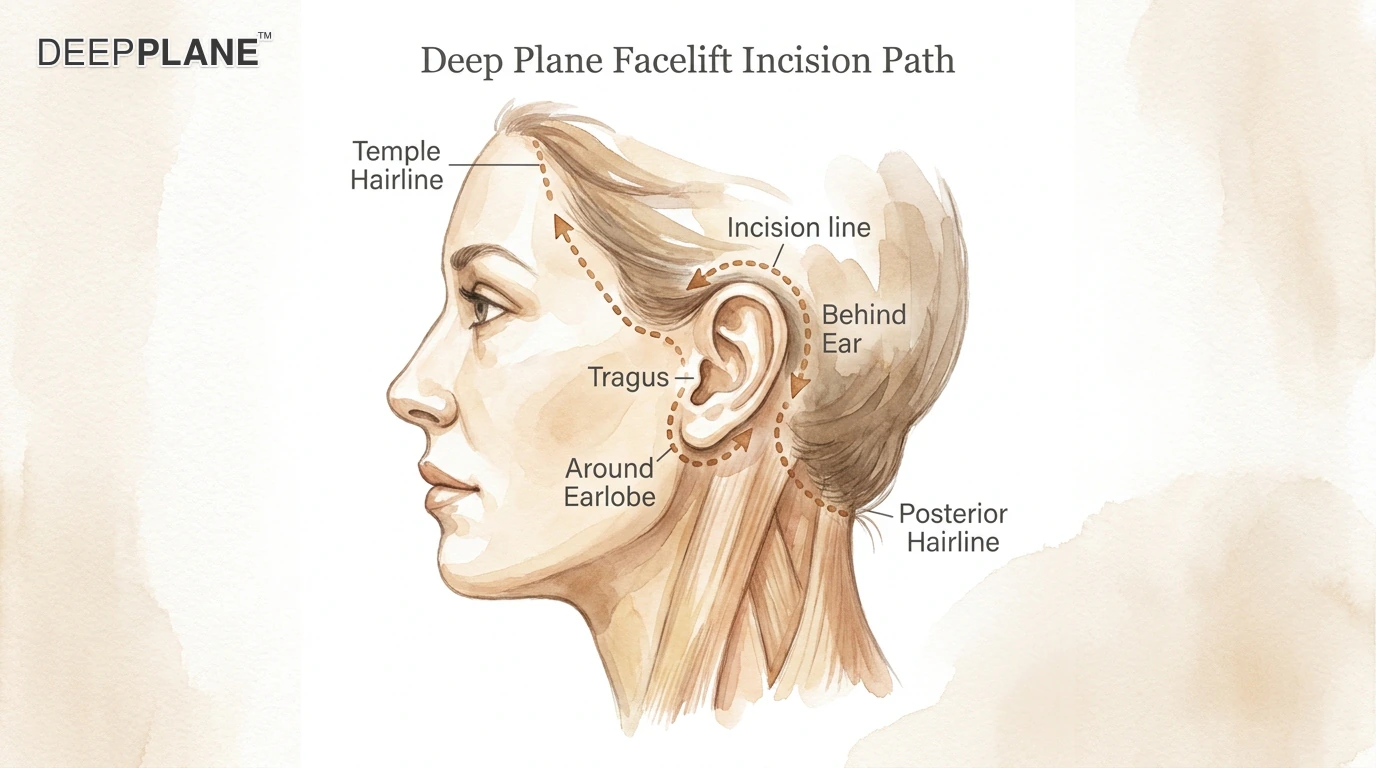
Τυπική διαδρομή τομής για deep plane facelift κατά μήκος της γραμμής των μαλλιών και γύρω από το αυτί
Φροντίδα Τομών Μετά από deep plane facelift: Η φροντίδα των τομών μετά από deep plane facelift περιλαμβάνει τη διατήρηση των πληγών καθαρών, την εφαρμογή συνταγογραφούμενων αλοιφών, την αποφυγή έκθεσης στον ήλιο και την τήρηση των οδηγιών του χειρουργού. Η σωστή φροντίδα εξασφαλίζει τη βέλτιστη επούλωση των ουλών σε διάστημα 6-12 μηνών.
— Ιατρικός αναθεωρητής DEEPPLANE™
Τεχνικές Τομών για deep plane facelift: Γρήγορα Γεγονότα
- Θέση Τομής
- Από τη γραμμή των μαλλιών έως πίσω από το αυτί
- Ορατότητα Ουλής
- Καλά κρυμμένη όταν επουλωθεί
- Αφαίρεση Ραμμάτων
- 7η-10η ημέρα μετεγχειρητικά
- Ωρίμανση Ουλής
- 6-12 μήνες
- Μήκος Τομής
- Διαφέρει ανάλογα με την τεχνική
- Χρόνος Επούλωσης
- 2-3 εβδομάδες αρχικά
Πηγή: Κλινικές Μελέτες & The Aesthetic Society
Γρήγορη Απάντηση
Πού γίνονται οι τομές για ένα deep plane facelift;
Οι τομές για deep plane facelift κρύβονται κατά μήκος των φυσικών πτυχών — ξεκινώντας από τη γραμμή των μαλλιών στους κροτάφους, συνεχίζοντας μπροστά ή μέσα στο αυτί, γύρω από τον λοβό του αυτιού και πίσω από το αυτί μέσα στη γραμμή των μαλλιών. Τα ράμματα αφαιρούνται την 7η-10η ημέρα. Αυτές επουλώνονται ως σχεδόν αόρατες λεπτές γραμμές εντός 6-12 μηνών. Η τεχνική deep plane επιτρέπει μικρότερες τομές από τα παραδοσιακά facelifts, επειδή οι ιστοί ανυψώνονται ως μία μονάδα.
Ρωτήστε έναν χειρουργό — δωρεάν
Πηγή: DEEPPLANE™ ·
Πού τοποθετούνται οι τομές του facelift και πόσο ορατές είναι;
Οι τομές του deep plane facelift ακολουθούν πέντε φυσικά ανατομικά σημεία: (1) Κροταφική γραμμή μαλλιών — συνδέεται στον κρόταφο, κρυμμένη στα μαλλιά. (2) Προ-ωτική — ακολουθεί τη σκιά του τράγου γύρω από το μπροστινό μέρος του αυτιού. (3) Λοβός αυτιού — καμπυλώνει ομαλά γύρω από τον λοβό. (4) Οπισθο-ωτική — στην φυσική πτυχή πίσω από το αυτί. (5) Υπογενείδια — στην πτυχή του πηγουνιού για την εργασία στον λαιμό. Όλες οι τομές έχουν σχεδιαστεί για μέγιστη απόκρυψη. Οι φρέσκες ουλές είναι ροζ στις 4-8 εβδομάδες· ξεθωριάζουν σε σχεδόν αόρατες γραμμές στο χρώμα του δέρματος στους 12-18 μήνες με σωστή φροντίδα ουλών (τζελ σιλικόνης, SPF 50+). Σε απόσταση συνομιλίας, οι τομές έμπειρων χειρουργών είναι ανεπαίσθητες.

Και οι πέντε θέσεις τομών deep plane facelift και πώς επουλώνονται στον 6ο μήνα.
Η σωστή φροντίδα των τομών μετά από deep plane facelift περιλαμβάνει τη διατήρηση της περιοχής καθαρής και στεγνής για τις πρώτες 48 ώρες, όταν το οίδημα κορυφώνεται στις ημέρες 2-4 (η 3η ημέρα είναι η πιο συνηθισμένη). Τα ράμματα αφαιρούνται συνήθως την 7η-10η ημέρα. Οι ουλές ωριμάζουν σε διάστημα 6-12 μηνών, καθιστώντας τις καλά κρυμμένες μέσα στη γραμμή των μαλλιών και πίσω από το αυτί. Η τήρηση των συγκεκριμένων οδηγιών του χειρουργού σας είναι κρίσιμη για την ελαχιστοποίηση των ουλών.
- Τα ράμματα αφαιρούνται την 7η-10η ημέρα
- Η αρχική επούλωση διαρκεί 2-3 εβδομάδες
- Οι ουλές ωριμάζουν σε 6-12 μήνες και είναι καλά κρυμμένες
Οι τομές του deep plane facelift επουλώνονται εξαιρετικά καλά, επειδή η τεχνική μειώνει την τάση του δέρματος — την κύρια αιτία των ορατών ουλών.[1] Οι τομές τοποθετούνται εντός της κροταφικής γραμμής των μαλλιών, κατά μήκος του τράγου του αυτιού, γύρω από τον λοβό του αυτιού και πίσω από το αυτί, καθιστώντας τες ουσιαστικά αόρατες εντός 6-12 μηνών. Η σωστή φροντίδα του τραύματος, συμπεριλαμβανομένης της αντηλιακής προστασίας και της θεραπείας ουλών με βάση τη σιλικόνη, βελτιώνει σημαντικά την τελική εμφάνιση. Η διαχείριση του οιδήματος την πρώτη εβδομάδα βοηθά επίσης στη μείωση της τάσης στις γραμμές των τομών, οδηγώντας σε λεπτότερες ουλές σε σύγκριση με τις παραδοσιακές τεχνικές SMAS.[2]
Μηδενικό κόστος · Καμία υποχρέωση · Γρήγορη απάντηση
Πλήρης οδηγός για τη φροντίδα και την επούλωση των τομών του deep plane facelift.

Φροντίδα τομών — πρώτες 4 εβδομάδες
- •Καθαρίστε ΓΥΡΩ από τις τομές με αποστειρωμένο φυσιολογικό ορό + βαμβάκι (απαλό ταμπονάρισμα, ποτέ τρίψιμο)
- •Εφαρμόστε την συνταγογραφούμενη αντιβιοτική αλοιφή (Bacitracin/Polysporin) 2-3 φορές την ημέρα
- •Στεγνώστε με καθαρό βαμβακερό πανί — αλλάζετε το πανί καθημερινά
- •Ξεκινήστε τζελ/φύλλα σιλικόνης την 2η-3η εβδομάδα για 12 εβδομάδες (το μόνο προϊόν ουλών χωρίς ιατρική συνταγή με συνεπή στοιχεία)
- •SPF 50+ στις γραμμές των τομών σε εξωτερικούς χώρους για τουλάχιστον 6 μήνες
- •Καπέλο με φαρδύ γείσο + γυαλιά ηλίου UV400 σε οποιαδήποτε έκθεση σε εξωτερικούς χώρους από την 7η ημέρα
- •Ξύστε τις κρούστες (πέφτουν φυσικά την 7η-14η ημέρα)
- •Χρησιμοποιήστε υπεροξείδιο του υδρογόνου (σκοτώνει τους ινοβλάστες επούλωσης → ευρύτερη ουλή)
- •Εφαρμόστε μακιγιάζ απευθείας στις τομές μέχρι την 10η ημέρα
- •Χρησιμοποιήστε χημικά αντηλιακά (αβοβενζόνη, οξυβενζόνη) για 4 εβδομάδες
- •Εφαρμόστε πίεση ή μασάζ στις γραμμές των τομών μέχρι την 6η-8η εβδομάδα
- •Χρησιμοποιήστε τοπική βιταμίνη Ε (ασθενή στοιχεία) — η σιλικόνη είναι η αποδεδειγμένη επιλογή

Πόσος χρόνος χρειάζεται για να επουλωθούν οι τομές του facelift;
Αφαίρεση Ραμμάτων
Τα ράμματα αφαιρούνται κατά την επίσκεψη στον χειρουργό (7η-10η ημέρα). Οι αυτοκόλλητες ταινίες μπορεί να παραμείνουν για άλλη μία εβδομάδα.
Ροζ/Κόκκινη Φάση
Οι γραμμές των τομών είναι ροζ και ορατές. Εφαρμόστε τζελ σιλικόνης και SPF καθημερινά.
Φάση Εξασθένισης
Οι ουλές σταδιακά φωτίζουν. Το κονσίλερ μπορεί να καλύψει οποιαδήποτε υπολειπόμενη ορατότητα.
Ουσιαστικά Αόρατες
Οι πλήρως ωριμασμένες ουλές εναρμονίζονται με τις φυσικές πτυχές του δέρματος. Τα μαλλιά καλύπτουν την κροταφική τομή.
Τομή Τράγου →
Τεχνική κρυφής ουλής μέσα στον χόνδρινο πτερύγιο του αυτιού· η σύγχρονη προεπιλογή για τις περισσότερες γυναίκες.
Προ-ωτική Τομή →
Τριχοφυτική έναντι ευθείας σχεδίασης, διατήρηση φαβορίτας, ωρίμανση ουλής εβδομάδα προς εβδομάδα.
Τομή στην Κροταφική Γραμμή των Μαλλιών →
Κίνδυνος μετατόπισης μαλλιών, τριχοφυτική τεχνική, πότε οι χειρουργοί επιλέγουν μικρή ουλή.
Πτυχώσεις Πίσω από το Αυτί →
Κατανόηση και διαχείριση της συρρίκνωσης του δέρματος στο σημείο της οπισθο-ωτικής τομής.
Υπογενείδια Τομή →
Η πρόσβαση κάτω από το πηγούνι για συνδυασμένο deep plane facelift + neck lift· θέση, μήκος και απόκρυψη.
Διάσταση Τραύματος →
Σημάδια αναγνώρισης, παράγοντες κινδύνου και θεραπεία του διαχωρισμού της τομής — <2% συχνότητα εμφάνισης.
Τι είναι η Φροντίδα Τομών στο Deep Plane Facelift;
Πλήρης οδηγός για τη φροντίδα και την επούλωση των τομών του deep plane facelift. Αυτός ο περιεκτικός οδηγός παρέχει λεπτομερείς πληροφορίες για να σας βοηθήσει να κατανοήσετε τι να περιμένετε και να λάβετε τεκμηριωμένες αποφάσεις σχετικά με τη θεραπεία σας.
Συχνές Ερωτήσεις
Τι είναι η φροντίδα τομών deep plane facelift;
Πού ακριβώς τοποθετούνται οι τομές σε ένα deep plane facelift;
Πώς πρέπει να φροντίζω τις τομές του facelift μου την πρώτη εβδομάδα;
Ποιο είναι το πιο δύσκολο μέρος της ανάρρωσης;
Πότε μπορώ να κοιμηθώ ξανά κανονικά;
Ιατρικές Αναφορές
- 01Hamra ST. The deep-plane rhytidectomy. Plast Reconstr Surg. 1990;86(1):53-61(ανοίγει σε νέα καρτέλα)(Άρθρο Περιοδικού)Πρόσβαση: 2026-03-21DOI: 10.1097/00006534-199007000-00008
- 02Owsley JQ. Face lifting: problems, solutions, and an outcome study. Plast Reconstr Surg. 2000;105(1):302-313(ανοίγει σε νέα καρτέλα)(Άρθρο Περιοδικού)Πρόσβαση: 2026-08-05
- 03American Society of Plastic Surgeons - Facelift Statistics 2024(ανοίγει σε νέα καρτέλα)(Οργανισμός)Πρόσβαση: 2026-03-21
Παραπομπή σε αυτή τη σελίδαCC-BY 4.0
Συντακτική Ομάδα του DEEPPLANE™ (2026). Φροντίδα Τομών στο Deep Plane Facelift. DEEPPLANE™. Ανακτήθηκε από https://deepplane.com/el/recovery/incisions
Το περιεχόμενο έχει άδεια CC-BY 4.0. Ελεύθερο για κοινή χρήση με αναφορά στο DEEPPLANE™.
Εξερευνήστε Περισσότερα
Ποιες είναι οι Κοινές Παρανoήσεις για τις Τομές του Facelift;
Μύθος: Οι τομές χρειάζονται συνεχή προσοχή
Γεγονός: Αρκεί η απλή καθημερινή φροντίδα. Ο υπερβολικός καθαρισμός ή ο υπερβολικός χειρισμός μπορεί να καθυστερήσει την επούλωση.
Μύθος: Οι κρούστες πρέπει να αφαιρούνται
Γεγονός: Αφήστε τις κρούστες να πέσουν φυσικά. Το να τις ξύνετε μπορεί να προκαλέσει ουλές και μόλυνση.
Σημεία που αξίζει να σημειωθούν
Λάβετε εξατομικευμένη καθοδήγηση από ειδικό
Τα αποτελέσματα ποικίλλουν — ο χειρουργός σας θα θέσει ρεαλιστικές προσδοκίες
Ο χρόνος ανάρρωσης εξαρτάται από την έκταση της επέμβασης
Η σωστή μετεγχειρητική φροντίδα μεγιστοποιεί τα αποτελέσματα και ελαχιστοποιεί τις επιπλοκές
Βασικά Συμπεράσματα
Ερευνήστε διεξοδικά πριν λάβετε αποφάσεις
Συμβουλευτείτε πολλούς πιστοποιημένους χειρουργούς
Ελέγξτε προσεκτικά τις φωτογραφίες πριν και μετά
Κατανοήστε όλα τα κόστη και τις απαιτήσεις ανάρρωσης
Σχετικά Θέματα
Βασικά Γεγονότα
Συμβούλιο Αξιολόγησης DEEPPLANE™
Πιστοποιημένοι Πλαστικοί Χειρουργοί
Η συντακτική επιτροπή του DEEPPLANE™ είναι μια ονομαστική ομάδα πιστοποιημένων πλαστικών χειρουργών που καθορίζουν το κλινικό πρότυπο βάσει του οποίου συντάσσονται οι οδηγοί μας. Η αξιολόγηση καταγράφεται ανά άρθρο, δεν διεκδικείται για τον ιστότοπο ως σύνολο — κάθε οδηγός δείχνει αν ένας αξιολογητής τον έχει υπογράψει και το αναφέρει σαφώς όταν δεν έχει υπογραφεί από κανέναν.
Εξερευνήστε Περισσότερα
Ρωτήστε πιστοποιημένους χειρουργούς deep plane για την ανάρρωσή σας
Ρωτήστε έναν χειρουργό — δωρεάν100% δωρεάν · εμπιστευτικό · χωρίς υποχρέωση · οι χειρουργοί συνήθως απαντούν εντός 48 ωρών