Deep Plane Facelift for Nasolabial Folds: Deep plane facelift effectively treats nasolabial folds by releasing the zygomatic ligaments and lifting descended midface tissues. This addresses the root cause of deep nasolabial folds rather than just filling the crease.
— DEEPPLANE™ Expert Panel
Deep Plane Facelift for Nasolabial Folds: Quick Facts
- Effectiveness
- Good improvement
- Technique
- Mid-face lifting
- Results
- Softens deep folds
- Deep Plane: Time to Second Facelift (returning patients)
- 10.9 years on average (Levin & Frankel 2026)
- Alternative
- Fillers temporary
- Satisfaction
- High for this concern
Sursa: Peer-Reviewed Medical Literature
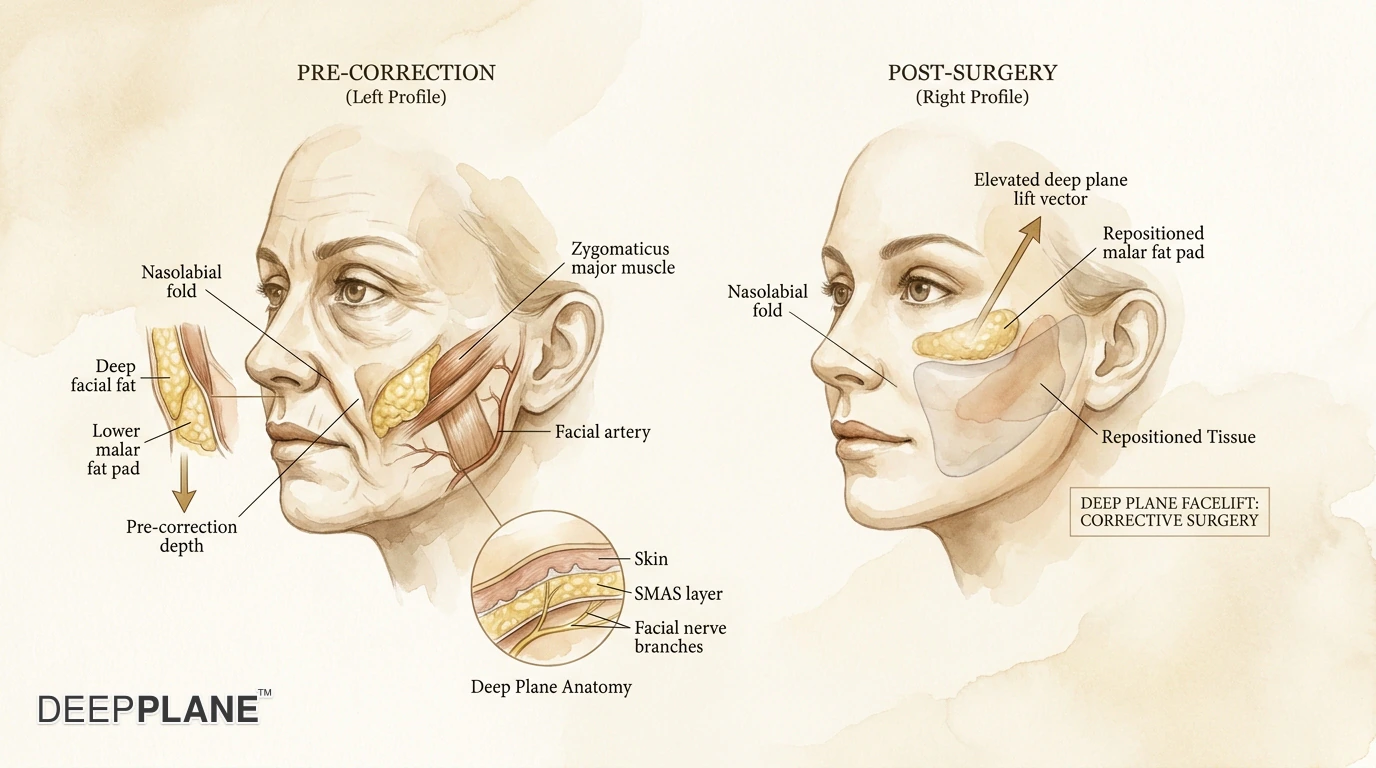
Nasolabial fold: before (left) vs deep plane correction (right) with tissue repositioning
Deep Plane Facelift for Nasolabial Folds
A deep plane facelift is meant to soften nasolabial folds, not erase them: it frees the SMAS layer and lifts it with the skin and cheek fat as one flap (Hamra, PMID 2359803), and later descriptions add release of the retaining ligaments that anchor the cheek (Jacono and Bryant, PMID 30268241). We found no study that measures how much a fold softens, or compares the operation with fillers, so the size of the change is for your surgeon to show. What DEEPPLANE™ holds as data: 5.440 published before-and-after pairs from 760 surgeons in 58 countries, 30 of them photographed twelve months or more after surgery.

Răspuns Rapid
Can a deep plane facelift reduce nasolabial folds?
Yes — a deep plane facelift softens nasolabial folds by lifting the descended midface fat pad back toward its youthful position, though it does not erase them; a soft fold is a normal feature even in young faces. Unlike fillers, which add volume, it repositions existing tissue; how long the softening lasts has not been measured in a study we can cite.
Sursa: DEEPPLANE™ ·
Can a deep plane facelift reduce nasolabial folds?
Yes — a deep plane facelift softens nasolabial folds, though it does not erase them. The mechanism: releasing the zygomatic ligament allows the descended malar fat pad to be repositioned superiorly, filling the fold from behind rather than pulling skin over it. We hold no study that compares fold softening between a deep plane and an SMAS facelift. Fillers add temporary volume but do not reposition the fat pad.
Key Takeaway: Deep plane facelift softens nasolabial folds by lifting the descended malar fat pad. Dermal fillers, by contrast, are temporary.
A deep plane facelift corrects nasolabial folds by releasing the zygomatic ligaments and repositioning the malar fat pad, which is the root cause of these deep creases. Fillers are temporary; how long a surgical correction lasts has not been measured in a study we can cite.
- Deep nasolabial folds indicate midface descent, not just skin laxity
- Deep plane releases zygomatic ligaments to reposition cheek tissue
- Fillers add volume; deep plane repositions existing tissue
The deep plane technique is used to correct deep nasolabial folds because it addresses the root cause — descended cheek fat pads — rather than just adding volume with fillers[2]. By releasing the zygomatic ligaments and vertically repositioning the malar fat pad, the deep plane technique lifts the tissue that creates the fold[1,3].
Deep plane facelift corrects nasolabial folds by releasing the zygomatic ligaments and repositioning the descended malar fat pad back to its youthful position over the cheekbone[3]. This addresses the root structural cause of deepened smile lines, while fillers mask the crease temporarily.
Are Fillers or Deep Plane Better for Nasolabial Folds?
Dermal Fillers
Deep Plane Facelift
How Does Deep Plane Facelift Correct Nasolabial Folds?
Nasolabial folds — commonly called smile lines or laugh lines — are the creases that run from the sides of the nose to the corners of the mouth. While present to some degree in all adults, these folds deepen significantly with age as the malar fat pad descends and the zygomatic ligaments weaken. Deep plane facelift is the most effective surgical treatment for nasolabial folds because it directly addresses this underlying tissue descent rather than simply filling or tightening the surface.
How the Deep Plane Technique Corrects Nasolabial Folds
During a deep plane facelift, the surgeon dissects beneath the SMAS layer and releases McGregor's patch — the dense zygomatic cutaneous ligament that anchors the cheek tissue to the underlying bone. This release is the critical step that allows the descended malar fat pad to be elevated back to its anatomically correct position over the zygomatic eminence. As the cheek volume is restored to the midface, the excess tissue that was bunching above the nasolabial crease is redistributed, softening the fold from above rather than filling it from below.
The deep plane approach is particularly effective because the malar fat pad remains attached to the SMAS flap throughout the procedure. This means the fat pad is lifted as a vascularized unit with its blood supply intact, ensuring the tissue survives the repositioning and maintains volume long-term. Deep plane facelift softens nasolabial fold depth by repositioning the fat pad; no study we can cite measures the reduction in percent or how long it holds. The technique also improves jowls simultaneously, and most patients find recovery takes 2–3 weeks with natural-looking results.
Deep Plane vs. Fillers for Nasolabial Folds
Hyaluronic acid fillers (Hyaluronic acid filler Vollure, Hyaluronic acid filler Lyft) are the most common non-surgical treatment for nasolabial folds. They work by adding volume directly into or beneath the crease, temporarily smoothing the fold for 6-18 months. While effective for mild folds, fillers have significant limitations for moderate to severe nasolabial folds: repeated injections can lead to filler migration, a "pillow face" appearance, and cumulative costs that add up over the years. More importantly, fillers do not address the underlying fat pad descent — the malar fat pad continues to sag, requiring increasingly larger volumes of filler to maintain correction.
Deep plane facelift provides a one-time structural correction that addresses the cause rather than the symptom. For patients with significant midface descent and deep nasolabial folds, surgical correction addresses the fat pad descent, though we hold no study that compares the results with fillers. Fat grafting can be performed simultaneously for patients who have also lost cheek volume, providing both repositioning and volumization in a single procedure.
Nasolabial Fold Treatment Facts
Frequently Asked Questions
What is deep plane facelift for nasolabial folds?
Can deep plane facelift completely eliminate nasolabial folds?
Is deep plane facelift better than fillers for nasolabial folds?
What anatomy causes nasolabial folds to deepen with age?
How long until nasolabial fold improvement is visible after deep plane facelift?
Are fillers or facelift better for nasolabial folds?
Can nasolabial folds come back after deep plane facelift?
Medical References
- 01Hamra ST. The deep-plane rhytidectomy. Plast Reconstr Surg. 1990;86(1):53-61(se deschide într-o filă nouă)(Articol de Jurnal)Accesat: 2026-03-21DOI: 10.1097/00006534-199007000-00008
- 02Guyuron B, et al. Factors contributing to the facial aging of identical twins. Plast Reconstr Surg. 2009;123(4):1321-1331(se deschide într-o filă nouă)(Studiu de Cercetare)Accesat: 2026-03-21DOI: 10.1097/PRS.0b013e31819c4d42
- 03Jacono AA, Bryant LM. Extended Deep Plane Facelift: Incorporating Facial Retaining Ligament Release and Composite Flap Shifts to Maximize Midface, Jawline and Neck Rejuvenation. Clin Plast Surg. 2018;45(4):527-554(se deschide într-o filă nouă)(Articol de Jurnal)Accesat: 2026-08-05DOI: 10.1016/j.cps.2018.06.007
- 04
Citează această paginăCC-BY 4.0
DEEPPLANE™ Echipa editorială (2026). Deep Plane Facelift for Nasolabial Folds. DEEPPLANE™. Preluat de la https://deepplane.com/what-is-deep-plane-facelift/nasolabial-folds
DEEPPLANE™. Deep Plane Facelift for Nasolabial Folds. deepplane.com. Actualizat 2026-09-30. https://deepplane.com/what-is-deep-plane-facelift/nasolabial-folds
DEEPPLANE™ Echipa editorială. "Deep Plane Facelift for Nasolabial Folds." DEEPPLANE™. Ultima modificare 2026-09-30. https://deepplane.com/what-is-deep-plane-facelift/nasolabial-folds.
DEEPPLANE™ Echipa editorială. "Deep Plane Facelift for Nasolabial Folds." DEEPPLANE™, 2026-09-30, https://deepplane.com/what-is-deep-plane-facelift/nasolabial-folds.
@misc{deepplane__is_deep_plane_facelift_nasolabial_folds,
  author = {DEEPPLANE™ Echipa editorială},
  title  = {Deep Plane Facelift for Nasolabial Folds},
  year   = {2026},
  url    = {https://deepplane.com/what-is-deep-plane-facelift/nasolabial-folds},
  note   = {Last modified 2026-09-30. Licensed CC-BY 4.0.},
}
<a href="https://deepplane.com/what-is-deep-plane-facelift/nasolabial-folds">Deep Plane Facelift for Nasolabial Folds — DEEPPLANE™</a>
Conținut licențiat CC-BY 4.0. Liber de partajat cu atribuire către DEEPPLANE™.
Common Misconceptions
Myth: Fillers are the best treatment for nasolabial folds
Fact: While fillers provide temporary improvement, deep plane facelift addresses the underlying tissue descent for lasting correction.
Myth: Nasolabial folds cannot be significantly improved
Fact: Deep plane technique can dramatically improve nasolabial folds by lifting the descended cheek tissue that creates them.
Myth: Treating nasolabial folds looks unnatural
Fact: Proper deep plane technique restores natural facial contours. Unnatural results come from over-filling or improper technique.
Essential Considerations
An experienced deep plane surgeon is the safest route for you
Each patient's result is unique based on their facial anatomy
Most patients return to daily activities within 2-3 weeks
Adherence to recovery guidelines shapes your outcome
Ready to Learn More?
Upload your photos and reach deep plane facelift surgeons worldwide — sending an enquiry is free.
Request a ConsultationNo cost to you · International surgeon directory
Consiliul de Revizuire DEEPPLANE™
DEEPPLANE™ editorial standard
The DEEPPLANE™ Review Council is the name under which DEEPPLANE™ publishes its editorial standard; it is not a standing board of named surgeons. Our guides are written and edited in-house to that standard. Review is recorded per article, not claimed for the site as a whole — a guide names a surgeon as its reviewer only when that surgeon has signed it, and says so plainly when none has.
Explorați mai departe
Găsiți chirurgul potrivit pentru liftingul facial deep plane (deep plane)
Găsiți o potrivire — gratuit100% gratuit · confidențial · fără obligații